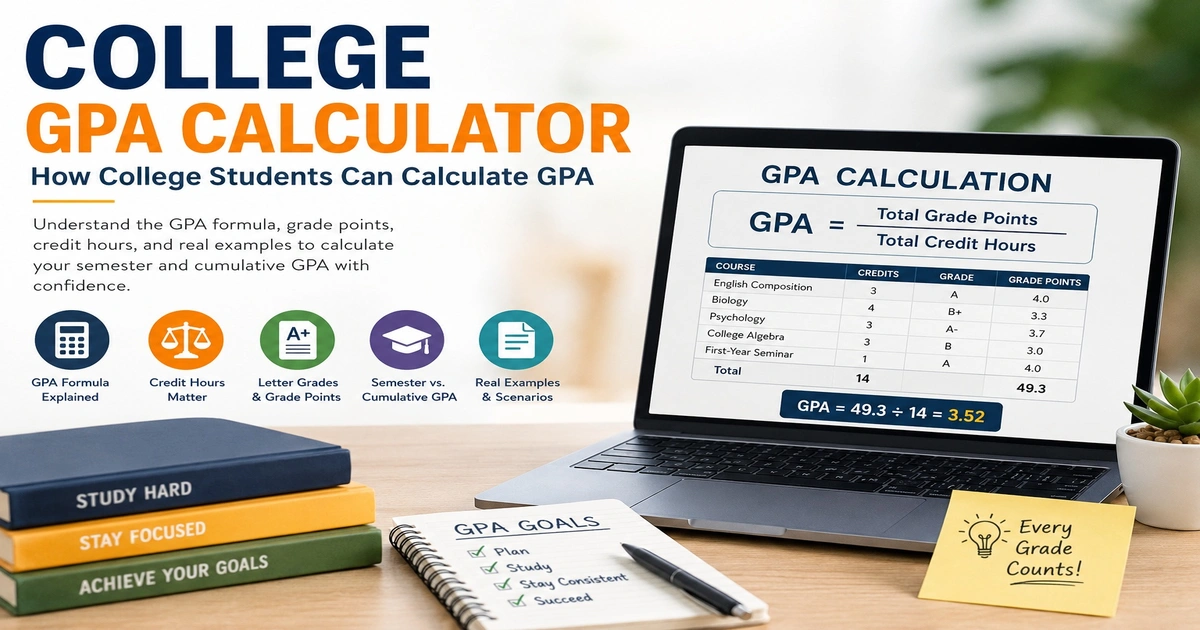
A college GPA calculator helps you estimate your semester GPA by using your college courses, letter grades, and credit hours.
That sounds simple, but college GPA is not just an average of grades. A 4-credit biology course usually affects your GPA more than a 1-credit lab, and an A in a low-credit class will not rescue your GPA the same way an A in a major 4-credit class can.
This is where many students get stuck. They know their letter grades, but they do not know how credits, grade points, plus/minus grading, repeated courses, transfer credits, pass/fail classes, and official transcript rules change the final number.
This guide explains how college GPA works, how to calculate it step by step, what makes semester GPA different from cumulative GPA, and when your calculator result may differ from your official transcript.
Key Takeaways
- College GPA is usually calculated using letter grades, grade point values, and credit hours.
- The basic formula is: GPA = Total Grade Points ÷ Total Credit Hours.
- A 4-credit course affects your GPA more than a 1-credit course.
- Semester GPA measures one term, while cumulative GPA combines multiple terms.
- Some colleges use plus/minus grades, while others use a no plus/minus grading scale.
- Pass/fail, withdrawal, incomplete, repeated, and transfer courses may be handled differently by each college.
- A GPA calculator gives a useful estimate, but your official GPA always depends on your college registrar’s rules.
What Is a College GPA?
College GPA, or Grade Point Average, is a number that summarizes your academic performance in college coursework.
Most U.S. colleges use a 4.0 GPA scale. On a common 4.0 scale, an A is usually worth 4.0 grade points, a B is worth 3.0, a C is worth 2.0, a D is worth 1.0, and an F is worth 0.0.
However, college GPA is usually credit-weighted. That means each course affects your GPA based on how many credits it carries.
For example:
| Course | Credits | Grade | Grade Points |
|---|---|---|---|
| English Composition | 3 | A | 4.0 |
| Biology | 4 | B | 3.0 |
| History | 3 | A- | 3.7 |
| College Algebra | 3 | C+ | 2.3 |
A college GPA calculator does not simply average A, B, A-, and C+. It multiplies each grade point value by the course credits first.
That is the part students often miss. Credit hours are the hidden weight behind the GPA.
Why College GPA Works Differently Than High School GPA
High school GPA and college GPA may look similar, but they are not always calculated the same way.
In high school, students often deal with honors, AP, IB, or weighted GPA scales. In college, the main weight usually comes from credit hours.
A 3-credit literature course and a 5-credit chemistry course do not carry the same GPA impact. If the chemistry course has more credits, it has more power over your final GPA for the term.
| GPA Factor | High School GPA | College GPA |
|---|---|---|
| Main input | Classes and grades | Courses, grades, and credits |
| Common weighting | Honors, AP, IB, advanced classes | Credit hours |
| Typical use | College applications, class rank, scholarships | Academic standing, major requirements, graduation, scholarships |
| Transcript impact | School-specific | Registrar-controlled and degree-policy based |
| Plus/minus system | Varies by school | Varies by college |
This is why a gpa calculator college students use should include credit hours. Without credits, the estimate can be too simple.
College GPA Formula
The standard college GPA formula is:
GPA = Total Grade Points ÷ Total Credit Hours
To get total grade points, use this formula for each course:
Course Grade Points = Grade Point Value × Credit Hours
Then add all course grade points together and divide by the total number of attempted GPA credits.
A registrar example from the University of Arizona explains the same process: units multiplied by grade point value gives class grade points, then total grade points divided by total units gives term GPA.
Common College Letter Grade Scale
Every college can set its own grading scale, so always check your syllabus, catalog, or registrar page. Still, many colleges use a version of the 4.0 scale like this:
| Letter Grade | Grade Point Value |
|---|---|
| A | 4.0 |
| A- | 3.7 |
| B+ | 3.3 |
| B | 3.0 |
| B- | 2.7 |
| C+ | 2.3 |
| C | 2.0 |
| C- | 1.7 |
| D+ | 1.3 |
| D | 1.0 |
| F | 0.0 |
Ohio State’s GPA calculation resource uses this kind of 4.0 scale, including plus and minus values such as A- = 3.7, B+ = 3.3, and C+ = 2.3.
Some colleges do not use plus/minus grading. In that case, the scale may be simpler:
| Letter Grade | No Plus/Minus Value |
|---|---|
| A | 4.0 |
| B | 3.0 |
| C | 2.0 |
| D | 1.0 |
| F | 0.0 |
If you need a college GPA calculator no plus minus method, use only the whole-letter values from your school’s grading policy.
How to Calculate College GPA Step by Step
Let’s calculate a semester GPA using a realistic college schedule.
Step 1: List Your Courses
Write down every graded course for the semester.
| Course | Credits | Grade |
|---|---|---|
| English Composition | 3 | A |
| Biology | 4 | B+ |
| Psychology | 3 | A- |
| College Algebra | 3 | B |
| First-Year Seminar | 1 | A |
Step 2: Convert Letter Grades to Grade Points
Now convert each letter grade into its GPA value.
| Course | Credits | Grade | Grade Point Value |
|---|---|---|---|
| English Composition | 3 | A | 4.0 |
| Biology | 4 | B+ | 3.3 |
| Psychology | 3 | A- | 3.7 |
| College Algebra | 3 | B | 3.0 |
| First-Year Seminar | 1 | A | 4.0 |
Step 3: Multiply Grade Points by Credits
Now multiply each grade point value by the course credits.
| Course | Credits | Grade Point Value | Course Grade Points |
|---|---|---|---|
| English Composition | 3 | 4.0 | 12.0 |
| Biology | 4 | 3.3 | 13.2 |
| Psychology | 3 | 3.7 | 11.1 |
| College Algebra | 3 | 3.0 | 9.0 |
| First-Year Seminar | 1 | 4.0 | 4.0 |
| Total | 14 | 49.3 |
Step 4: Divide Total Grade Points by Total Credits
Now apply the formula:
GPA = Total Grade Points ÷ Total Credit Hours
GPA = 49.3 ÷ 14
GPA = 3.52
Your semester GPA is 3.52.
College GPA Example With a Lower Grade in a High-Credit Course
Here is where college GPA gets real.
Suppose you earned an A in two 3-credit courses, but a C in a 5-credit science course.
| Course | Credits | Grade | Grade Point Value | Course Grade Points |
|---|---|---|---|---|
| English | 3 | A | 4.0 | 12.0 |
| History | 3 | A | 4.0 | 12.0 |
| Chemistry | 5 | C | 2.0 | 10.0 |
| Art Elective | 2 | B | 3.0 | 6.0 |
| Total | 13 | 40.0 |
GPA = 40.0 ÷ 13
GPA = 3.08
Even with two A grades, the 5-credit C pulls the GPA down. College credits do not play around. They are the quiet boss in the room.
Semester GPA vs Cumulative GPA
A semester GPA measures your GPA for one term only.
A cumulative GPA measures your overall GPA across all completed college terms.
| GPA Type | Meaning | Best Use |
|---|---|---|
| Semester GPA | GPA for one semester or term | Checking current term performance |
| Term GPA | Another name for semester GPA | Registrar and transcript reporting |
| Cumulative GPA | Overall GPA across multiple terms | Academic standing, graduation, scholarships |
| Major GPA | GPA in major-specific courses | Major requirements, graduate school, department review |
| Transfer GPA | GPA from previous college coursework | Transfer admissions and scholarship review |
If you only want to calculate one term, use a gpa college calculator with courses, grades, and credits.
If you already know your semester GPAs and want to combine multiple terms, use the cumulative GPA calculator instead.
How to Calculate Overall College GPA
An overall college GPA calculator combines multiple semesters by credit hours.
Do not average semester GPAs directly unless every semester has the same number of credits.
Here is the correct method:
Overall GPA = Total Grade Points Across All Terms ÷ Total Credits Across All Terms
Example:
| Term | GPA | Credits | Term Grade Points |
|---|---|---|---|
| Fall Semester | 3.20 | 15 | 48.0 |
| Spring Semester | 3.60 | 12 | 43.2 |
| Summer Term | 4.00 | 6 | 24.0 |
| Total | 33 | 115.2 |
Overall GPA = 115.2 ÷ 33
Overall GPA = 3.49
This is why an overall GPA calculator college students use should include credits for each term. A 6-credit summer term should not have the same impact as a 15-credit fall semester.
College GPA Calculator for Quarter System Students
Some colleges use semesters. Others use quarters.
The GPA formula is still the same:
GPA = Total Grade Points ÷ Total Credits
The difference is the credit system. Quarter credits and semester credits are not always equal. A college GPA calculator quarter method should use the credits exactly as your college reports them for that term.
Example quarter schedule:
| Course | Quarter Credits | Grade | Grade Point Value | Course Grade Points |
|---|---|---|---|---|
| Biology | 5 | A- | 3.7 | 18.5 |
| Sociology | 4 | B+ | 3.3 | 13.2 |
| Statistics | 5 | B | 3.0 | 15.0 |
| Writing | 4 | A | 4.0 | 16.0 |
| Total | 18 | 62.7 |
Quarter GPA = 62.7 ÷ 18
Quarter GPA = 3.48
Important: if you are transferring between quarter and semester schools, do not guess the conversion. Colleges may convert credits differently, and your registrar or transfer evaluation controls the official result.
Community College GPA Calculator: What to Know
A community college GPA calculator works the same way as a four-year college GPA calculator if the school uses letter grades and credits.
Use it for:
- Associate degree planning
- Transfer admissions
- Nursing or allied health program requirements
- Scholarship eligibility
- Academic probation checks
- Major prerequisite planning
- Graduation requirement tracking
The main thing community college students should watch is transfer credit policy. Your community college GPA may matter for transfer admission, but your new college may not include those transfer grades in your new institutional GPA.
Many colleges record accepted transfer credits separately, often without adding the old grades into the new school’s GPA calculation. The University of Olivet explains that new schools typically do not include transfer credits in GPA calculation, although those credits may still count toward degree requirements.
Weighted GPA Calculator College Students Actually Need
In college, “weighted GPA” usually means something different from high school.
High school weighted GPA often means extra grade points for honors, AP, or IB classes.
College weighted GPA usually means credit-weighted GPA.
That means a course with more credits has more impact.
| Course Type | Example | GPA Impact |
|---|---|---|
| 1-credit course | Seminar, lab, activity course | Small impact |
| 3-credit course | Standard lecture course | Normal impact |
| 4-credit course | Science, math, language course | Higher impact |
| 5-credit course | Lab-heavy or intensive course | Very high impact |
So when students search for a weighted GPA calculator college tool, they usually need a calculator that weighs grades by credit hours, not one that adds AP-style bonus points.
Final GPA Calculator College Students May Need
The phrase final gpa calculator college can mean two different things.
Sometimes students mean:
“How do I calculate my final GPA for the semester?”
In that case, use your final letter grades and credits in the college GPA calculator.
Other times students mean:
“What grade do I need on my final exam to reach a target course grade?”
That is a different problem. For that, use a final grade calculator, because the calculation depends on your current course grade, target course grade, and final exam weight.
Use the right calculator for the right job:
| Student Question | Best Calculator |
|---|---|
| What is my GPA this semester? | College GPA calculator |
| What is my cumulative GPA after several terms? | Cumulative GPA calculator |
| What grade do I need on my final exam? | Final grade calculator |
| What is my current percentage in one class? | Grade calculator |
Why Your Calculator GPA May Differ From Your Official Transcript
A college GPA calculator gives an estimate based on the information you enter. Your official transcript GPA may be different because colleges apply detailed academic policies.
Here are the most common reasons.
1. Your College Uses a Different Grade Scale
Some colleges use plus/minus grading. Others do not.
For example, one college may count an A- as 3.7. Another may count all A-range grades as 4.0 or may not use A+ at all.
Small scale differences can change your GPA.
2. Pass/Fail Courses May Not Count in GPA
Many colleges allow some courses to be taken pass/fail or pass/no pass.
These courses may earn credits but not grade points. UCLA’s catalog says units earned with a P grade count toward degree requirements but do not affect GPA.
That means a passed course may help you move toward graduation without raising or lowering your GPA.
3. Withdrawals Usually Do Not Work Like F Grades
A W grade often means you withdrew from the course after a deadline. In many systems, it appears on the transcript but does not calculate into GPA.
However, policies vary. A late drop, unofficial withdrawal, or failing withdrawal can be treated differently depending on the school.
4. Incomplete Grades May Change Later
An incomplete grade may not count in GPA right away, but it can change when the missing work is completed or when the incomplete expires.
UCLA’s registrar explains that an incomplete remains on the transcript until resolved or lapsed, after which the resulting grade is displayed.
So your GPA may change later if an incomplete turns into a final letter grade.
5. Repeated Courses Can Be Handled Differently
Repeated course rules are one of the biggest transcript differences.
Some colleges replace the old grade. Some average both attempts. Some count the highest grade only for undergraduates but use different rules for graduate students.
The University of Arizona states that for undergraduate students repeating regular graded undergraduate courses, GPA reflects only the highest grade earned, while all grades remain on the academic record. It also notes that graduate and professional repeated courses may be handled differently.
This is exactly why calculator results can differ from transcript results. The math is easy. The policy is the maze.
6. Transfer Credits May Count for Degree Progress, Not GPA
Transfer credits can help you meet graduation requirements, but they may not affect your GPA at the new institution.
For example, your new college may accept 30 credits from a community college but start your institutional GPA from the courses you take after transfer.
Always check whether your school reports:
- Institutional GPA
- Transfer GPA
- Overall GPA
- Major GPA
- Degree GPA
Those can be different numbers.
Edge Cases College Students Should Know
Edge Case 1: What If a Course Has Zero Credits?
A zero-credit course usually should not affect GPA because it adds no credit hours. It may appear on your transcript for requirements, labs, orientation, or milestones, but it usually does not change the GPA math.
Edge Case 2: What If You Take a Lab Separately?
Some colleges list labs as separate 1-credit courses. Others combine the lab with the lecture.
If the lab has its own grade and credits, include it. If it is bundled into the lecture course, do not count it separately.
Edge Case 3: What If Your School Does Not Use Plus/Minus Grades?
Use the no plus/minus scale.
Example:
| Grade | Value |
|---|---|
| A | 4.0 |
| B | 3.0 |
| C | 2.0 |
| D | 1.0 |
| F | 0.0 |
Do not enter B+ or A- if your official transcript does not use those grades.
Edge Case 4: What If You Have Percentage Grades?
Convert the percentage to the official letter grade first.
For example, your syllabus might say:
| Percentage | Letter Grade |
|---|---|
| 93 to 100 | A |
| 90 to 92 | A- |
| 87 to 89 | B+ |
| 83 to 86 | B |
| 80 to 82 | B- |
Do not use a random internet scale if your college provides its own grade table.
Edge Case 5: What If You Are Retaking a Failed Course?
Check your college repeat policy before calculating.
If your school replaces the old grade, your GPA may improve more. If it counts both attempts, the improvement may be smaller.
Edge Case 6: What If You Are Planning Future Grades?
You can enter expected grades to estimate a future semester GPA. Just remember that the result is a planning estimate, not an official GPA.
How to Use an Online GPA Calculator College Students Can Trust
An online GPA calculator college students use should ask for three basic inputs:
- Course name
- Letter grade
- Credit hours
Then it should multiply grade points by credits and divide by total credits.
Here is the clean process:
- Add each graded college course.
- Choose the letter grade from your school’s scale.
- Enter the correct credit hours.
- Exclude pass/fail courses unless your school includes them in GPA.
- Exclude withdrawals unless your school treats them as GPA-bearing.
- Calculate the GPA.
- Compare the estimate with your official transcript after grades post.
If you want a GPA calculator college simply built for quick planning, use one that keeps the inputs focused on grades and credits. Too many settings can turn basic GPA math into a spaceship dashboard.
College GPA Planning Example
Let’s say you want to know if you can reach a 3.50 semester GPA.
Your current expected grades are:
| Course | Credits | Expected Grade | Grade Point Value | Grade Points |
|---|---|---|---|---|
| English | 3 | A | 4.0 | 12.0 |
| Biology | 4 | B | 3.0 | 12.0 |
| Psychology | 3 | A- | 3.7 | 11.1 |
| Algebra | 3 | B+ | 3.3 | 9.9 |
| Seminar | 1 | A | 4.0 | 4.0 |
| Total | 14 | 49.0 |
GPA = 49.0 ÷ 14
GPA = 3.50
This means your expected grades would put you right at a 3.50 semester GPA.
If Biology moved from B to B+, the new grade points would be:
B+ = 3.3 × 4 credits = 13.2
That adds 1.2 more grade points.
New total grade points:
49.0 + 1.2 = 50.2
New GPA:
50.2 ÷ 14 = 3.59
One grade change in a 4-credit course can move the GPA noticeably.
How to Improve Your College GPA Strategically
If your goal is to raise your GPA, focus on the courses with the highest credit value first.
A better grade in a 4-credit or 5-credit course usually has more impact than a better grade in a 1-credit course.
| Action | GPA Impact |
|---|---|
| Improve a 1-credit course from B to A | Small |
| Improve a 3-credit course from B to A | Medium |
| Improve a 5-credit course from C to B | Large |
| Retake a failed course if your policy allows grade replacement | Potentially large |
| Switch a difficult elective to pass/fail when allowed | May protect GPA |
Important: do not make pass/fail or withdrawal decisions only from a calculator. Talk to an academic advisor because these decisions can affect financial aid, major requirements, graduation progress, and graduate school applications.
When Should You Use a College GPA Calculator?
Use a college GPA calculator when you want to:
- Estimate your semester GPA before grades are official
- Check whether you may qualify for Dean’s List
- See how a high-credit course affects your GPA
- Plan scholarship eligibility
- Track academic probation risk
- Estimate your GPA before transferring
- Compare plus/minus and no plus/minus grading
- Plan future grades for a target GPA
- Understand why your official transcript GPA changed
The calculator is especially useful before final grades post, when you still have time to improve assignments, prepare for exams, or talk with your instructor.
College GPA Calculator vs Other Student Calculators
College GPA is only one part of academic planning. Use the right tool depending on the question.
| Calculator | Best For | Example Question |
|---|---|---|
| College GPA calculator | One semester or group of college courses | What is my GPA this term? |
| Cumulative GPA calculator | Multiple semesters | What is my overall GPA? |
| Final grade calculator | Final exam planning | What score do I need on my final? |
| Grade calculator | One course percentage | What is my current grade in this class? |
A total GPA calculator college students need for all semesters should use cumulative GPA logic. A semester calculator should use course-level grades and credits.
Final Thoughts
A college GPA calculator helps you estimate your GPA, but college GPA is more than a plain average.
You need letter grades, grade point values, and credit hours. Then you multiply each grade value by credits, add the grade points, and divide by total GPA credits.
The biggest thing to remember is this: official transcript rules matter. Plus/minus grading, repeated courses, pass/fail classes, transfer credits, withdrawals, incompletes, and quarter-term credits can all change what appears on your final academic record.
Use the College GPA Calculator to estimate your GPA quickly, then check your college catalog, syllabus, or registrar page for the official rules.
FAQs
What is a college GPA calculator?
A college GPA calculator is a tool that estimates your college GPA using course grades and credit hours. It converts letter grades into grade point values, multiplies them by credits, and divides total grade points by total credits.
How do I calculate college GPA?
To calculate college GPA, multiply each course’s grade point value by its credit hours. Add all course grade points together, then divide by total credit hours.
What is the college GPA formula?
The college GPA formula is: GPA = Total Grade Points ÷ Total Credit Hours. Course grade points are calculated as Grade Point Value × Credit Hours.
Is college GPA weighted by credits?
Yes, college GPA is usually weighted by credit hours. A 4-credit course affects your GPA more than a 1-credit course.
What is a good GPA in college?
A good college GPA depends on your goal. Many students aim for 3.0 or higher for general academic standing, 3.5 or higher for stronger scholarship or graduate school positioning, and higher GPAs for competitive programs. Always check your program’s requirements.
Can I use a GPA calculator for community college?
Yes. A community college GPA calculator works the same way if your school uses letter grades and credit hours. Enter each course, grade, and credit value.
What is an overall college GPA calculator?
An overall college GPA calculator estimates your cumulative GPA across multiple college terms. It should combine grade points and credits from all terms instead of simply averaging semester GPAs.
What is a weighted GPA calculator for college?
A weighted GPA calculator for college usually means a credit-weighted GPA calculator. It gives more impact to courses with more credit hours.
How do I calculate college GPA without plus or minus grades?
Use your school’s no plus/minus scale. For example, A = 4.0, B = 3.0, C = 2.0, D = 1.0, and F = 0.0. Do not enter A-, B+, or C+ if your official transcript does not use them.
Does pass/fail count toward college GPA?
Often, pass/fail courses earn credit but do not affect GPA. However, policies vary by college, so check your registrar or academic catalog.
Do transfer credits affect college GPA?
Transfer credits may count toward degree requirements, but many colleges do not include transfer grades in the new institution’s GPA. Your transfer GPA may still matter for admission, scholarships, and program placement.
Does a repeated course replace the old GPA grade?
It depends on your college policy. Some colleges count the highest attempt, some replace the old grade, and some count both attempts. Always check your school’s repeated course rules.
Can I calculate college GPA for a quarter system?
Yes. Use the same GPA formula, but enter the quarter credits exactly as your college reports them. Do not convert quarter credits unless your school tells you to.
Why is my calculated GPA different from my transcript GPA?
Your calculated GPA may differ because of plus/minus rules, repeated courses, pass/fail classes, transfer credits, withdrawals, incomplete grades, rounding, or transcript-specific policies.
Can I use expected grades in a college GPA calculator?
Yes. You can enter expected grades to estimate a future GPA. The result is useful for planning, but it is not official until your college posts final grades.