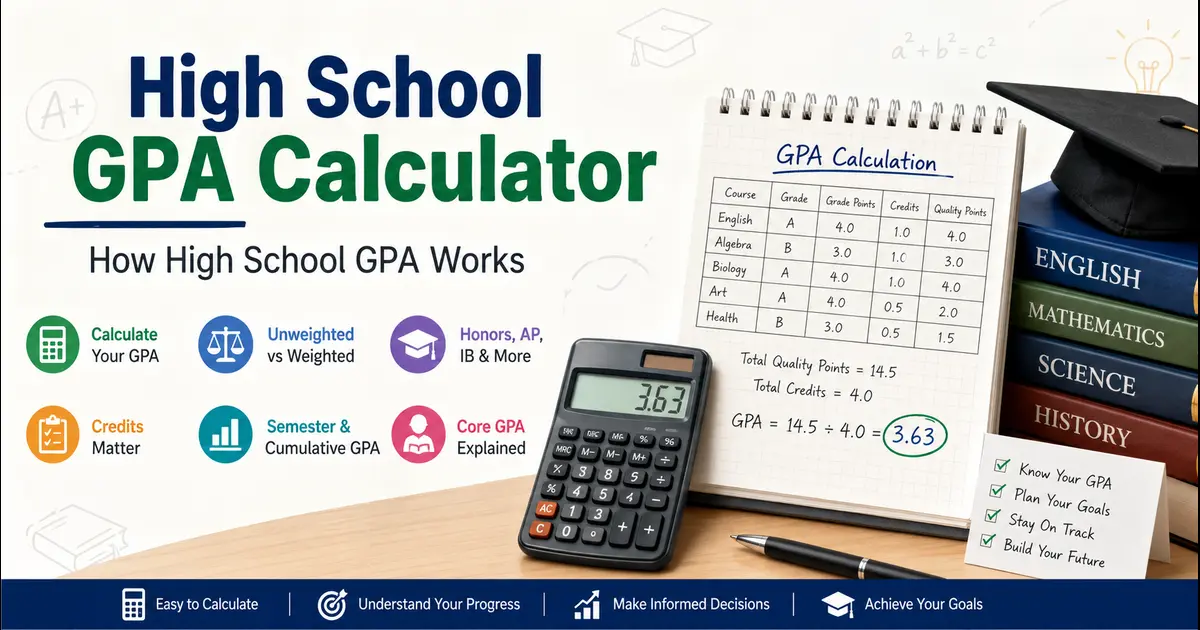
High school GPA summarizes your academic performance across your courses. This guide explains how to calculate unweighted and weighted GPA, how credits affect the result, how percentage grades are converted, and why grading policies vary by school. To calculate your own GPA from courses, grades, and credits, use our GPA Calculator.
That sounds simple until your transcript starts throwing numbers at you. One class uses letter grades, another shows percentages, your school may add extra points for honors or AP, and your counselor may talk about weighted GPA, unweighted GPA, semester GPA, cumulative GPA, and core GPA like everyone was born knowing this stuff.
Most students are not trying to become grading-policy experts. They just want to know: “What is my GPA, how is it calculated, and what do my grades actually mean?”
At StudentCalcTools, the goal is to make that answer easier. This guide explains how high school GPA works, how to calculate it manually, where credits matter, how weighted classes affect GPA, and when to use a calculator for a faster result.
Key Takeaways
- High school GPA is usually calculated by converting course grades into grade points, then averaging them.
- A common unweighted GPA scale uses 4.0 for an A, 3.0 for a B, 2.0 for a C, and 1.0 for a D.
- Weighted GPA may give extra points for honors, AP, IB, or dual-enrollment classes.
- Credits matter when one course is worth more than another.
- Semester GPA measures one term, while cumulative GPA measures your overall high school record.
- A core GPA may include only academic courses such as English, math, science, social studies, and world language.
- A GPA calculator high school students can use is helpful when grades, credits, and course levels are mixed.
What Is High School GPA?
High school GPA stands for grade point average. It is a number that summarizes your academic performance across your classes.
Instead of looking at every individual grade, schools convert grades into grade points and average them.
For example:
| Letter Grade | Common Grade Point |
|---|---|
| A | 4.0 |
| B | 3.0 |
| C | 2.0 |
| D | 1.0 |
| F | 0.0 |
So if you earn mostly A’s and B’s, your GPA will usually be higher. If you earn C’s, D’s, or F’s, your GPA will usually drop.
Many schools and colleges use a 4.0 GPA scale as a standard reference point. College Board’s BigFuture explains GPA as a grade point average commonly reported on a 4.0 scale, although exact school rules can vary.
Why High School Students Search for a GPA Calculator
Most students search for a high school GPA calculator because their transcript is not always easy to understand.
You may need to calculate GPA because:
| Student Situation | Why GPA Matters |
|---|---|
| You want to know your current academic standing | GPA gives a quick summary of grades |
| You are applying to college | GPA is part of many admissions reviews |
| You want to qualify for scholarships | Some scholarships require a minimum GPA |
| You play sports | Athletic eligibility may depend on grades |
| You are taking AP or honors classes | Weighted GPA may apply |
| You need to improve before senior year | GPA planning helps you set realistic goals |
| You want to understand your transcript | GPA shows how grades combine over time |
A GPA number is not the whole story, but it is one of the main numbers students track during high school.
Unweighted GPA vs Weighted GPA
The first major GPA difference is unweighted vs weighted.
What Is an Unweighted GPA?
An unweighted GPA treats all classes the same, no matter how hard they are.
A regular English class and an AP English class may both use the same 4.0 scale.
Example:
| Grade | Unweighted Points |
|---|---|
| A | 4.0 |
| B | 3.0 |
| C | 2.0 |
| D | 1.0 |
| F | 0.0 |
So if you get an A in a regular class, it is usually 4.0. If you get an A in an AP class, it may still be 4.0 on an unweighted scale.
What Is a Weighted GPA?
A weighted GPA gives extra value to more difficult courses, depending on your school’s policy.
For example:
| Course Type | A Grade Might Count As |
|---|---|
| Regular | 4.0 |
| Honors | 4.5 |
| AP or IB | 5.0 |
This is why some students have a GPA above 4.0. They may be taking advanced courses that receive extra weight.
Not every school weights classes the same way. Some schools add 0.5 for honors and 1.0 for AP. Some use a 5.0 scale. Some do not weight GPA at all. The only official answer is your school’s GPA policy.
Basic High School GPA Formula
The basic unweighted GPA formula is:
GPA = Total Grade Points ÷ Number of Classes
Example:
| Course | Grade | Grade Points |
|---|---|---|
| English | A | 4.0 |
| Algebra | B | 3.0 |
| Biology | A | 4.0 |
| History | B | 3.0 |
| Spanish | C | 2.0 |
Now add the grade points:
4.0 + 3.0 + 4.0 + 3.0 + 2.0 = 16.0
Then divide by the number of classes:
16.0 ÷ 5 = 3.2
Your GPA is 3.2.
That is the simple version. It works when all classes count equally and no credits or weights are involved.
How Credits Affect High School GPA
Some schools calculate GPA using credits. This matters because one class may be worth more than another.
For example, a full-year class may carry more credit than a semester elective.
The credit-based GPA formula is:
GPA = Total Quality Points ÷ Total Credits
Quality points are calculated like this:
Grade Points × Credits = Quality Points
Example:
| Course | Grade | Grade Points | Credits | Quality Points |
|---|---|---|---|---|
| English | A | 4.0 | 1.0 | 4.0 |
| Algebra | B | 3.0 | 1.0 | 3.0 |
| Biology | A | 4.0 | 1.0 | 4.0 |
| Art | A | 4.0 | 0.5 | 2.0 |
| Health | B | 3.0 | 0.5 | 1.5 |
| Total | 4.0 | 14.5 |
Now divide quality points by credits:
14.5 ÷ 4.0 = 3.625
Your GPA is 3.63 if rounded to two decimal places.
This is why a cumulative GPA calculator high school students use often asks for credits. If credits are ignored, the result may be less accurate.
Estimating GPA When Credits Are Not Available
Some students need a high school GPA calculator without credits because their school treats every class equally or because they do not know the credit value.
In that case, use the simple average method:
GPA = Total Grade Points ÷ Number of Classes
Example:
| Class | Grade | Grade Points |
|---|---|---|
| English | A | 4.0 |
| Math | A | 4.0 |
| Science | B | 3.0 |
| History | B | 3.0 |
Calculation:
4.0 + 4.0 + 3.0 + 3.0 = 14.0
14.0 ÷ 4 = 3.5
Your GPA is 3.5.
This method is useful for a quick estimate, but if your school uses credits, weighted classes, or different course values, a no-credit estimate may not match your official transcript.
Converting Number Grades to GPA
Some students do not have letter grades yet. They have number grades such as 92, 87, or 76.
A GPA calculator high school number grades method usually converts percentages into letter grades or grade points.
A common example looks like this:
| Number Grade | Letter Grade | Grade Points |
|---|---|---|
| 90 to 100 | A | 4.0 |
| 80 to 89 | B | 3.0 |
| 70 to 79 | C | 2.0 |
| 60 to 69 | D | 1.0 |
| Below 60 | F | 0.0 |
Example:
| Course | Number Grade | Letter Grade | Grade Points |
|---|---|---|---|
| English | 94 | A | 4.0 |
| Math | 88 | B | 3.0 |
| Science | 91 | A | 4.0 |
| History | 79 | C | 2.0 |
Now calculate:
4.0 + 3.0 + 4.0 + 2.0 = 13.0
13.0 ÷ 4 = 3.25
Estimated GPA: 3.25
Important: number-grade conversion varies by school. Some schools use plus/minus grading, where an A- may be 3.7 and a B+ may be 3.3. Others use only whole letter grades. Always check your school’s grading scale.
Weighted High School GPA Example
Now let’s calculate a weighted GPA.
Assume this school uses:
| Course Type | A | B | C |
|---|---|---|---|
| Regular | 4.0 | 3.0 | 2.0 |
| Honors | 4.5 | 3.5 | 2.5 |
| AP | 5.0 | 4.0 | 3.0 |
Student grades:
| Course | Type | Grade | Weighted Points |
|---|---|---|---|
| English | Regular | A | 4.0 |
| Algebra II | Honors | B | 3.5 |
| AP Biology | AP | A | 5.0 |
| U.S. History | Regular | B | 3.0 |
| Spanish | Honors | A | 4.5 |
Add the weighted points:
4.0 + 3.5 + 5.0 + 3.0 + 4.5 = 20.0
Divide by 5 classes:
20.0 ÷ 5 = 4.0
Weighted GPA: 4.0
The same grades on an unweighted scale would be:
| Course | Grade | Unweighted Points |
|---|---|---|
| English | A | 4.0 |
| Algebra II | B | 3.0 |
| AP Biology | A | 4.0 |
| U.S. History | B | 3.0 |
| Spanish | A | 4.0 |
Calculation:
4.0 + 3.0 + 4.0 + 3.0 + 4.0 = 18.0
18.0 ÷ 5 = 3.6
Unweighted GPA: 3.6
Same student. Same grades. Different GPA because weighted courses add extra value.
Semester GPA vs Cumulative GPA
A semester GPA measures performance during one grading period, while cumulative GPA combines results from multiple terms.
A cumulative high school GPA calculator looks at all completed semesters or years.
| GPA Type | What It Measures |
|---|---|
| Semester GPA | GPA for one semester only |
| Yearly GPA | GPA for one school year |
| Cumulative GPA | GPA across all completed high school courses |
| Overall GPA | Usually another name for cumulative GPA |
Example:
| Term | GPA |
|---|---|
| Freshman Fall | 3.2 |
| Freshman Spring | 3.4 |
| Sophomore Fall | 3.6 |
| Sophomore Spring | 3.5 |
Your cumulative GPA is not always the simple average of these term GPAs if credits differ. The more accurate method is to combine total quality points and total credits across all terms.
That is why an overall high school GPA calculator should ideally account for credits if your school uses them.
What Is Core GPA?
Core GPA is different from overall GPA.
A core GPA usually includes only main academic subjects, such as:
- English
- Math
- Science
- Social studies
- World language
It may exclude electives, physical education, art, music, or other non-core classes.
Student-athletes should pay special attention to core GPA because eligibility rules may use approved core courses rather than every course on the transcript. The NCAA explains that not all high school courses are NCAA-approved core courses and that Division I eligibility uses approved core-course credits and GPA requirements.
For regular college planning, your school GPA and transcript GPA still matter. But if you are an athlete, ask your counselor which courses count as approved core courses.
What Does Final High School GPA Mean?
The phrase final GPA calculator high school can mean two different things.
Some students mean:
- Final GPA after the semester ends
- Final cumulative GPA after graduation
These are not exactly the same.
| Search Intent | What It Means |
|---|---|
| Final semester GPA | Your GPA after current semester grades are added |
| Final high school GPA | Your cumulative GPA after all high school courses are complete |
| Final exam impact | How a final exam affects one course grade |
If you are trying to calculate the final exam score needed in one class, use the final grade calculator.
If you are trying to calculate your GPA after final grades are entered, use the GPA calculator.
How Course Grades Affect GPA
Every course grade affects GPA through grade points.
Here is a simple example:
| Grade | GPA Effect |
|---|---|
| A | Raises or protects GPA |
| B | Usually keeps GPA solid |
| C | Can lower GPA if your average is above 2.0 |
| D | Usually lowers GPA significantly |
| F | Strong negative impact because it adds 0 grade points |
The impact also depends on credits.
A B in a one-credit class affects GPA more than a B in a half-credit class. This is why students should not only look at the letter grade. They should also check how much the course is worth.
If your school shows number grades first, you can use a grade calculator to estimate course grades before converting them into GPA points.
Common High School GPA Mistakes
High school GPA gets messy when students mix different systems.
| Mistake | Why It Causes Problems |
|---|---|
| Mixing weighted and unweighted GPA | These are different calculations |
| Ignoring credits | A half-credit class should not always count the same as a full-credit class |
| Using the wrong grade scale | Some schools use plus/minus grades |
| Assuming AP always adds 1.0 | Weighting rules vary by school |
| Including non-core classes in core GPA | Core GPA may exclude electives |
| Averaging semester GPAs without credits | This can be inaccurate |
| Treating percentages as GPA points directly | A 92 is not a 9.2 GPA |
| Forgetting repeated-course policies | Some schools replace grades, others average attempts |
The biggest mistake is assuming there is one universal GPA system. There is not. The formula is consistent, but school policies vary.
Edge Cases That Can Change Your GPA
1. Honors and AP Weighting
Some schools give extra GPA points for honors, AP, IB, or dual-enrollment courses. Others do not. Some only weight certain approved courses.
Check your student handbook, transcript guide, or counselor notes.
2. Plus and Minus Grades
Some schools use a scale like this:
| Grade | Points |
|---|---|
| A | 4.0 |
| A- | 3.7 |
| B+ | 3.3 |
| B | 3.0 |
| B- | 2.7 |
This can make GPA more precise, but it also means an 89 and a 90 may convert differently.
3. Repeated Courses
If you retake a course, your school may:
- Replace the old grade
- Average both attempts
- Keep both grades on the transcript
- Count only the higher grade for GPA
- Count one grade for credit but show both attempts
Do not guess here. Retake policies are school-specific.
4. Pass or Fail Classes
Pass or fail courses may not always affect GPA. A passing grade may earn credit without grade points, depending on school policy.
5. Transfer Credits
If you transfer schools, some credits may be recalculated under the new school’s GPA rules. This can change your GPA compared with your old transcript.
6. Middle School Classes for High School Credit
Some students take Algebra I, Geometry, or world language before ninth grade and receive high school credit. Whether those grades count toward high school GPA depends on district policy.
7. Core GPA for Athletes
For NCAA-style eligibility, core-course GPA may not include every class. Approved academic courses matter most. This is why student-athletes should review core course requirements early instead of waiting until senior year.
How to Calculate Cumulative High School GPA
To calculate cumulative GPA, combine all courses across all completed terms.
Use this formula:
Cumulative GPA = Total Quality Points Across All Terms ÷ Total Credits Across All Terms
Example:
| Year | Quality Points | Credits |
|---|---|---|
| Freshman Year | 24.0 | 7.0 |
| Sophomore Year | 26.6 | 7.0 |
| Junior Year | 28.0 | 7.0 |
| Total | 78.6 | 21.0 |
Now divide:
78.6 ÷ 21.0 = 3.742
Cumulative GPA: 3.74
A cumulative GPA calculator high school students use should ideally account for all course credits and grade points across multiple terms.
How to Improve Your High School GPA
Once you know your GPA, the next question is usually, “Can I improve it?”
Yes, but the amount depends on how many credits you have already completed.
A freshman can move GPA faster because fewer grades are locked in. A senior can still improve, but every new grade has to compete against more completed credits.
Here are practical ways to improve GPA:
| Strategy | Why It Helps |
|---|---|
| Focus on high-credit classes | They affect GPA more |
| Protect core academic grades | Colleges and eligibility programs often care about core courses |
| Turn in missing work | Zeroes damage grades fast |
| Improve before finals | Final grades are what usually hit the transcript |
| Ask about retake policies | Some schools replace lower grades |
| Use study planning | Better time allocation can improve outcomes |
| Track GPA each semester | Early fixes are easier than late rescues |
If finals are coming up, use a study time planner to prioritize the classes where a better final grade can make the biggest GPA difference.
GPA Calculator vs Grade Calculator
These two tools are related, but they solve different problems.
| Tool | Best For |
|---|---|
| GPA calculator | Calculating grade point average from course grades |
| Grade calculator | Calculating a class grade from assignments, tests, and weights |
| Final grade calculator | Finding what score you need on a final exam |
| Class rank calculator | Estimating rank position based on GPA or class standing |
Use the GPA calculator when you already know your course grades and want your GPA.
Use the grade calculator when you need to calculate the grade inside one class first.
Use the class rank calculator if you are trying to understand how GPA may compare with others in your class.
College Board notes that class rank is commonly based on a student’s GPA compared with other students in the class, and that course difficulty may also be considered.
Quick Checklist Before You Calculate High School GPA
Before using an online GPA calculator high school students can rely on, collect the right information.
| Question | Your Answer |
|---|---|
| Are you calculating weighted or unweighted GPA? | ___ |
| Do you have letter grades or number grades? | ___ |
| Does your school use credits? | ___ |
| Are honors, AP, IB, or dual-enrollment classes weighted? | ___ |
| Are you calculating semester GPA or cumulative GPA? | ___ |
| Are you including only core classes or all classes? | ___ |
| Does your school use plus/minus grades? | ___ |
| Are repeated courses handled differently? | ___ |
If you know these answers, your GPA estimate will be much more accurate.
Final Thoughts
High school GPA looks complicated because schools use different grading rules. But the basic idea is simple: convert grades into points, adjust for credits or course weight if needed, then divide by the total classes or credits.
For a simple unweighted GPA:
GPA = Total Grade Points ÷ Number of Classes
For a credit-based GPA:
GPA = Total Quality Points ÷ Total Credits
For weighted GPA, use the weighted grade points assigned by your school for honors, AP, IB, or advanced courses.
Use the formula when you want to understand how GPA works. Use the GPA calculator when you want a faster estimate with fewer mistakes.
FAQs
What is a high school GPA calculator?
A high school GPA calculator is a tool that estimates your GPA using your course grades, grade points, credits, and sometimes weighted course levels such as honors or AP.
How do I calculate high school GPA?
Convert each course grade into grade points, add the points, and divide by the number of classes. If your school uses credits, multiply grade points by credits first, then divide total quality points by total credits.
What is the difference between weighted and unweighted GPA?
Unweighted GPA uses the same scale for all classes, usually up to 4.0. Weighted GPA gives extra points for harder classes such as honors, AP, IB, or dual-enrollment courses, depending on school policy.
Can I calculate high school GPA without credits?
Yes. If all classes count equally, add the grade points and divide by the number of classes. If your school uses credits, a no-credit calculation may only be an estimate.
How do number grades convert to GPA?
Number grades usually convert into letter grades first, then into grade points. For example, a 90 to 100 may count as an A or 4.0, depending on your school’s grading scale.
What is cumulative GPA in high school?
Cumulative GPA is your overall GPA across multiple semesters or school years. It combines all completed high school courses included in your school’s GPA policy.
What is semester GPA in high school?
Semester GPA is your GPA for one semester only. It uses the grades and credits from that term, not your full high school record.
What is core GPA in high school?
Core GPA usually includes only academic courses such as English, math, science, social studies, and world language. Some athletic eligibility systems use core GPA instead of overall GPA.
Can high school GPA go above 4.0?
Yes, if your school uses a weighted GPA scale. Honors, AP, IB, or dual-enrollment courses may allow GPAs above 4.0.
Is an online GPA calculator high school students use always exact?
No. It is an estimate unless it uses your school’s exact grading scale, credit rules, weighting policy, and transcript rules. Your official GPA comes from your school.