Class rank shows where a student stands academically compared with other students in the same graduating class. A rank of 12 out of 240 means that 11 students are ranked ahead of that student.
Calculating an official class rank requires more than knowing one GPA. Schools normally compare the academic records of everyone in the ranked group, sort those records according to their ranking policy, and assign each student a position.
Once you know your official rank and graduating class size, you can use the Class Rank Calculator to find your percentile rank and approximate top percentage. This guide explains the complete process, including formulas, examples, tied GPAs, weighted and unweighted ranking, and what to do when your school does not publish rank.
What Does Class Rank Mean?
Class rank is a numerical summary of a student’s academic position within a specific graduating class. Schools generally calculate it by comparing cumulative GPAs, although the exact method varies.
Students who need to calculate their cumulative GPA first can use our GPA Calculator before reviewing their class standing.
For example:
- Rank 1 out of 300 means the student holds the highest ranked position.
- Rank 30 out of 300 places the student at approximately the top 10% of the class.
- Rank 150 out of 300 places the student near the middle of the class.
Class rank is a relative measure. GPA, by contrast, measures only an individual student’s academic performance.
A 3.9 GPA might produce a very high rank at one school but a lower rank at another. The result depends on the performance of other students, the school’s GPA scale, course-weighting rules, and the ranking method.
The College Board’s explanation of class rank notes that schools commonly consider both grades and the difficulty of the courses students complete. However, each school establishes its own calculation policy.
How Is Class Rank Calculated?
Class rank is created through a sorting process rather than one universal equation.
A school generally follows these steps:
- Calculate each student’s cumulative GPA.
- Apply the school’s weighted or unweighted GPA policy.
- Identify which students belong to the ranked cohort.
- Sort student records from highest to lowest.
- Apply the school’s rules for tied GPAs.
- Assign a numbered position to each student.
Suppose a school has five graduating students with these GPAs:
| Student | GPA |
|---|---|
| Student A | 4.35 |
| Student B | 4.21 |
| Student C | 4.10 |
| Student D | 3.96 |
| Student E | 3.82 |
After sorting the GPAs, Student A receives rank 1, Student B receives rank 2, and Student C receives rank 3.
The process becomes more complicated when students have identical GPAs or when a school considers course rigor, credits, or additional academic criteria.
Class Rank Percentile Formula
Raw class rank tells you your numbered position. Percentile rank expresses that position as a percentage, making it easier to compare results across different class sizes.
StudentCalcTools uses the following inclusive percentile-rank formula:
Percentile Rank = ((Class Size − Class Rank + 1) ÷ Class Size) × 100
The added 1 includes the student’s own position in the percentile calculation.
Example
A student is ranked 25 out of a class of 300.
Percentile Rank = ((300 − 25 + 1) ÷ 300) × 100
Percentile Rank = (276 ÷ 300) × 100
Percentile Rank = 92
The student is at approximately the 92nd percentile.
This means the student’s position is at or above roughly 92% of the ranked class when using the inclusive method.
How to Calculate Your Top Percentage
Students and colleges also describe class standing as a top percentage, such as top 5%, top 10%, or top 25%.
Use this formula:
Top Percentage = (Class Rank ÷ Class Size) × 100
Using the same example:
Top Percentage = (25 ÷ 300) × 100
Top Percentage = 8.33%
The student is therefore within approximately the top 8.3% of the graduating class.
Schools may round results differently. A school could report this student as top 9%, top 10%, or in the top decile, depending on its reporting policy.
Step-by-Step Example
Suppose a student is ranked 18 out of 240.
Step 1: Confirm the rank and class size
- Class rank: 18
- Total class size: 240
Step 2: Calculate percentile rank
((240 − 18 + 1) ÷ 240) × 100
(223 ÷ 240) × 100 = 92.9
The student is at approximately the 92.9th percentile.
Step 3: Calculate the top percentage
(18 ÷ 240) × 100 = 7.5
The student is within the top 7.5% of the graduating class.
Step 4: Check the school’s reporting policy
The school may report the result as:
- Rank 18 out of 240
- 92.9th percentile
- Top 7.5%
- Top 10%
- First quartile
- Top decile
All of these formats describe the same general standing, but they are not interchangeable in every application or scholarship program.
How Schools Handle Tied GPAs
Tied GPAs are one of the most important parts of class-rank calculation. When two or more students have the same GPA, the school must decide how to assign their positions.
There are three common ranking methods.
Competition Ranking
Students with equal GPAs receive the same rank, and the next position is skipped.
For example:
- Rank 1
- Rank 2
- Rank 2
- Rank 4
If two students tie for second place, both receive rank 2. The next student receives rank 4 because three students occupy positions above or at that point.
Dense Ranking
Students with equal GPAs receive the same rank, but the next position is not skipped.
For example:
- Rank 1
- Rank 2
- Rank 2
- Rank 3
This method produces fewer gaps between numbered ranks.
Fractional Ranking
Students with equal records receive the average of the positions they would have occupied.
If two students would otherwise hold positions 5 and 6, both receive a rank of 5.5.
Additional Tiebreakers
Some schools avoid tied ranks by using additional criteria, such as:
- GPA calculated to more decimal places
- Number of advanced courses completed
- Total weighted quality points
- Core academic GPA
- Number of honors credits
- Course rigor
- Credits attempted or completed
Students should check their school handbook, transcript policy, or counselor guidance before assuming which system is used.
Can You Calculate Class Rank From GPA and Class Size?
GPA and class size alone are not enough to calculate an exact class rank.
Consider two students who both have a 4.1 weighted GPA in graduating classes of 400 students. One might rank 20th at a school where few students exceed a 4.0. The other might rank 90th at a school where advanced courses and GPAs above 4.0 are common.
To estimate rank responsibly, you need information about the distribution of GPAs in the class.
Useful information may include:
- Number of students in each GPA range
- Percentage of students above a particular GPA
- Class quartiles or deciles
- Median GPA
- Highest reported GPA
- School weighting rules
- Number of students tied at each GPA
- A scattergram or anonymized academic distribution
NACAC’s school-profile guidance recommends that school profiles explain GPA calculations, grade distribution, ranking methodology, weighting policies, and class-rank reporting. That makes the school profile one of the best places to look for reliable academic context.
Example of Estimating Class Standing
Suppose a graduating class contains 500 students. The school profile reports that 15% of students have a weighted GPA of 4.2 or higher.
Calculate the number of students in that group:
500 × 0.15 = 75
A student with a 4.2 GPA could reasonably describe their estimated standing as approximately within the top 15%, or around rank 75 or better.
However, this is not an exact rank.
The student’s precise position depends on:
- How many students have a GPA above 4.2
- How many students have exactly 4.2
- How the school handles ties
- Whether additional ranking factors are used
A responsible estimate should therefore be presented as a range or broad percentage, not an official numbered rank.
For example:
Estimated within the top 15% based on the school’s published GPA distribution.
It would be misleading to claim:
Official rank 75 out of 500.
Only the school can issue the official rank.
Weighted vs. Unweighted Class Rank
Schools may calculate rank using weighted GPA, unweighted GPA, or a district-specific academic formula.
Weighted Class Rank
Weighted GPA gives additional value to advanced coursework, such as:
- Advanced Placement courses
- International Baccalaureate courses
- Honors courses
- Dual-enrollment courses
A student with a 4.3 weighted GPA may have earned that number by completing advanced courses carrying additional grade points.
Unweighted Class Rank
Unweighted GPA normally uses a fixed scale, often with 4.0 as the highest standard value. Course difficulty does not directly add extra grade points.
A standard-level A and an AP-course A may both count as 4.0 under a fully unweighted system.
Neither system is universally correct. Weighted ranking rewards course rigor, while unweighted ranking makes grades easier to compare on a common scale.
Before comparing your GPA with class-rank data, review how weighted and unweighted GPA are calculated at your school.
Rank, Percentile, Quartile, and Decile
Schools do not always report an exact numbered rank. Some use broader categories to protect student privacy or reduce competition.
Exact Rank
An exact rank gives a specific position.
Example:
36 out of 420
Percentile Rank
A percentile describes a student’s relative position as a percentage.
Example:
91.7th percentile
Top Percentage
A top percentage states how close the student is to the highest position.
Example:
Top 8.6%
Quartile
A quartile divides the class into four groups.
- First quartile: top 25%
- Second quartile: 26% to 50%
- Third quartile: 51% to 75%
- Fourth quartile: bottom 25%
Decile
A decile divides the class into ten groups.
A student in the top decile is within the highest 10% of the class. A student in the second-highest decile generally falls between the top 10% and top 20%.
Because terminology can differ, “top decile” is usually clearer than “first decile.”
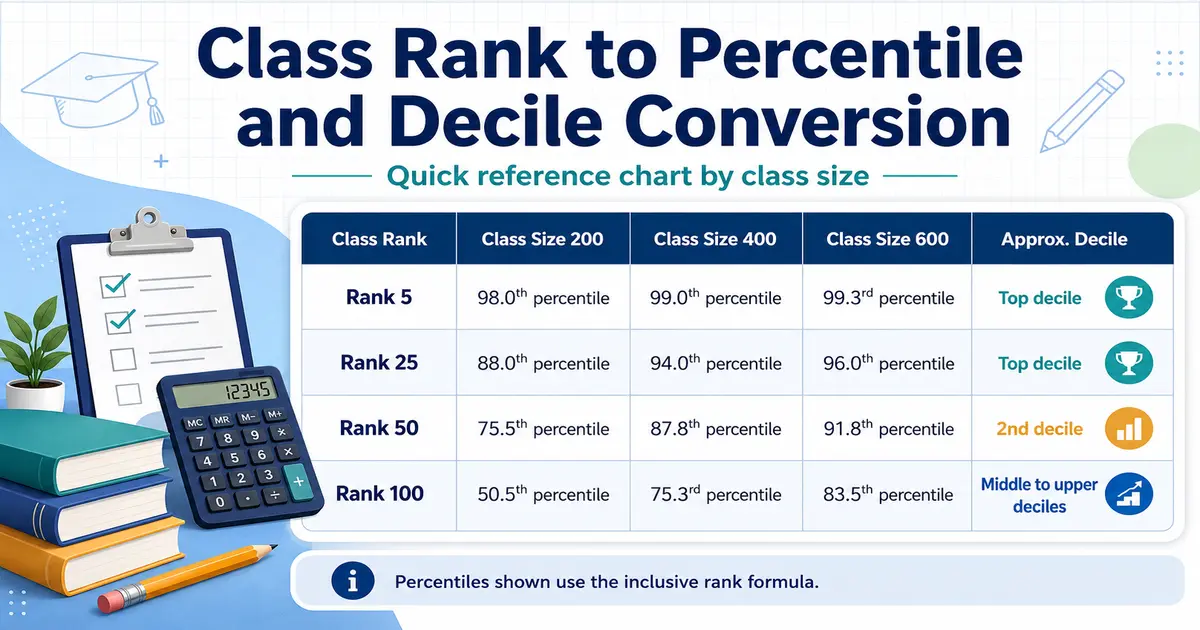
Rank-to-Percentile Quick Reference
The following results use the inclusive percentile-rank formula explained above.
| Class Rank | Class Size 200 | Class Size 400 | Class Size 600 |
|---|---|---|---|
| Rank 5 | 98.0th percentile | 99.0th percentile | 99.3rd percentile |
| Rank 25 | 88.0th percentile | 94.0th percentile | 96.0th percentile |
| Rank 50 | 75.5th percentile | 87.8th percentile | 91.8th percentile |
| Rank 100 | 50.5th percentile | 75.3rd percentile | 83.5th percentile |
These figures are mathematical conversions. They do not determine how a school, college, or scholarship program will categorize the student.
Does Class Rank Matter for College Admissions?
Class rank can provide colleges with useful context, but it is only one part of an application.
According to NACAC’s Fall 2023 admission data, 5.5% of surveyed four-year colleges rated high school class rank as having considerable importance in first-year admission decisions. Another 22.4% gave it moderate importance.
By comparison, 76.8% rated grades in college-preparatory courses as considerably important, and 63.8% gave the same rating to the strength of the high school curriculum.
These figures show that class rank still matters at some institutions, but strong grades and challenging coursework generally carry more weight across the surveyed colleges.
Class rank may have greater importance when:
- A state offers automatic admission based on top percentage
- A scholarship has a class-rank requirement
- A college evaluates applicants within their school context
- A high school reports rank consistently
- An academic award requires top-decile or top-quartile standing
Students should check the exact requirements of each college or scholarship rather than assuming one general rule applies everywhere.
What If Your School Does Not Rank Students?
Some high schools do not calculate class rank. Others calculate it internally but do not include it on student transcripts.
When a school does not rank, colleges may receive other forms of academic context, including:
- GPA distribution
- Course rigor
- Grade trends
- School profile
- Highest available courses
- Counselor recommendations
- Quartile or decile information
- Comparison with previous graduating classes
Do not invent an official rank for a college application.
The Common App’s class-rank guidance instructs applicants to select “None” when their school does not rank.
You may still estimate your standing for personal planning, but the estimate should not be presented as an official school-issued result.
Common Class-Rank Mistakes
Treating GPA and Rank as the Same Thing
GPA measures personal academic performance. Rank compares that performance with other students.
Using GPA and Class Size Alone
Without class-distribution data, these two numbers cannot establish an exact rank.
Mixing Weighted and Unweighted GPAs
Comparing a weighted GPA with an unweighted class distribution produces a misleading result.
Ignoring Tied GPAs
A large tie group can change the meaning of a numbered rank.
Reporting an Estimate as Official
Only the school can confirm an official rank.
Assuming All Schools Use the Same Formula
Ranking policies vary by school, district, state, and graduating cohort.
Confusing Percentile With Top Percentage
A high percentile corresponds to a low top percentage. For example, a student near the 95th percentile is generally close to the top 5%.
Frequently Asked Questions
How is class rank calculated?
Schools typically calculate class rank by comparing cumulative GPAs, sorting student records from highest to lowest, applying tie rules, and assigning numbered positions. Schools may use weighted GPA, unweighted GPA, or another academic formula.
Can I calculate my own class rank?
You can convert a known class rank into a percentile if you know your rank and total class size. You cannot calculate an exact rank from GPA and class size alone unless you also have enough information about the academic records of the rest of the class.
What percentile is top 10%?
A student in the top 10% is generally near or above the 90th percentile. Exact results depend on the percentile formula and rounding method used.
Is class rank based on weighted or unweighted GPA?
It depends on the school. Some schools use weighted GPA, some use unweighted GPA, and others use district-specific ranking formulas. Check your transcript or school ranking policy.
How are tied GPAs ranked?
Schools may use competition ranking, dense ranking, fractional ranking, additional decimal places, or academic tiebreakers. There is no single method used by every school.
What if my school does not provide class rank?
Check your school profile for GPA distributions, quartiles, deciles, or other academic context. You may use that information to estimate a broad range for personal planning, but you should not report the estimate as an official rank.
Does class rank change during high school?
It can. Some schools update class rank after each semester, while others calculate it annually or only at specific points. Your school counselor or registrar can confirm the schedule.
Is a high GPA always equal to a high class rank?
No. Rank depends on how your GPA compares with the rest of your graduating class. The same GPA can produce different ranks at different schools.
Final Thoughts
Calculating class rank begins with understanding what the number represents. Schools compare students within a graduating class, apply their own GPA and tie-breaking policies, and assign positions based on those rules.
When you already know your rank and class size, converting the result into a percentile or top percentage is straightforward. When your school does not rank, a reliable estimate requires GPA-distribution or percentile data. GPA and class size alone are not enough.
Treat online calculations as planning tools, verify official figures with your school, and review the site’s calculator methodology to understand how results are produced and interpreted.