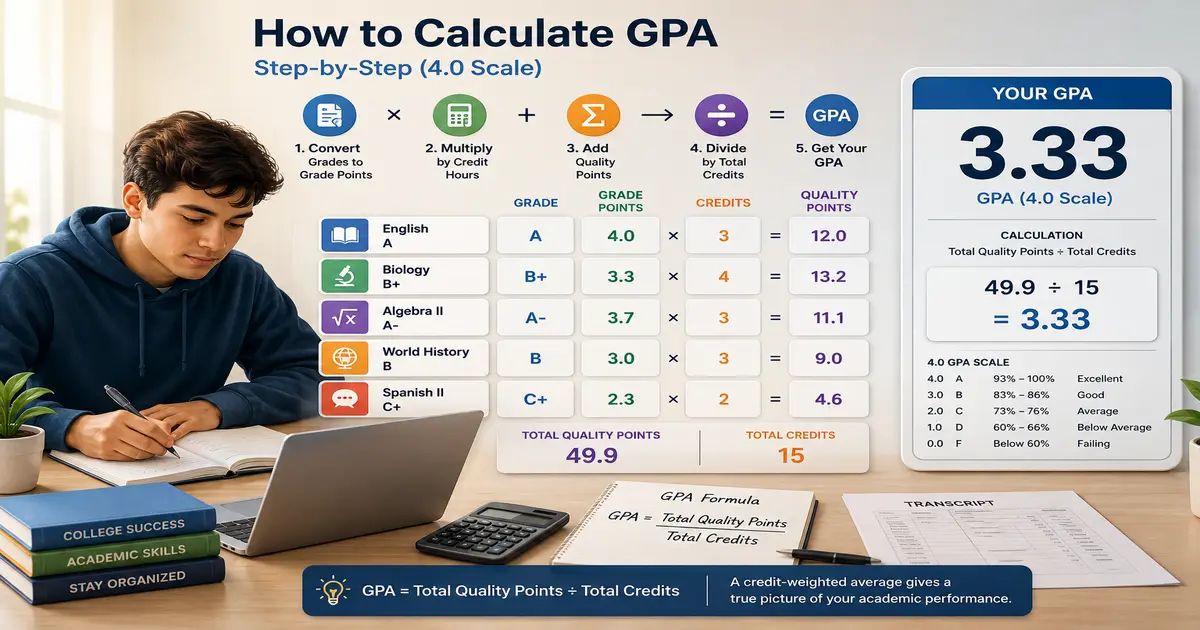
GPA is calculated by converting each course grade into grade points, multiplying those points by the course’s credit hours to get quality points, adding up the quality points across all your courses, then dividing by your total credit hours. The formula is GPA = Total Quality Points ÷ Total Credits. If every course carries the same number of credits, this simplifies to a plain average of your grade points, but as soon as credit hours differ between courses, the credit-weighting is what makes the number accurate.
To skip the manual math once you know the method, the GPA calculator handles a single semester instantly, and the CGPA calculator combines multiple semesters into one cumulative figure.
What GPA Actually Measures
Your Grade Point Average condenses every grade on your transcript into one number that reflects both how well you did and how much academic weight each course carried. If you’re searching for how to figure out GPA by hand for the first time, the part that catches people off guard isn’t the concept, it’s realizing a GPA is not a simple average of letter grades, it’s a credit-weighted average, which means a strong grade in a 4-credit course moves your GPA more than the same grade in a 1-credit course. Adding up grade points and dividing by the number of classes only works if every class happens to carry identical credit hours, which is rare.
The 4.0 Grade Point Scale
Each letter grade converts to a grade point value on the standard 4.0 scale:
| Letter Grade | Grade Points | Percentage Range | Standing |
|---|---|---|---|
| A | 4.0 | 93% to 100% | Excellent |
| A- | 3.7 | 90% to 92% | Excellent |
| B+ | 3.3 | 87% to 89% | Good |
| B | 3.0 | 83% to 86% | Good |
| B- | 2.7 | 80% to 82% | Good |
| C+ | 2.3 | 77% to 79% | Average |
| C | 2.0 | 73% to 76% | Average |
| C- | 1.7 | 70% to 72% | Average |
| D+ | 1.3 | 67% to 69% | Below Average |
| D | 1.0 | 60% to 66% | Below Average |
| F | 0.0 | Below 60% | Failing |
This is the most common version of the scale, but it isn’t universal. Some schools add an A+ worth 4.3 or 4.33, some skip plus/minus grades entirely and only use whole letters, and some use different percentage cutoffs. Always confirm your own school’s exact scale before treating any calculation as official.
The GPA Formula
GPA = Total Quality Points ÷ Total Credits
Where a quality point is calculated per course as:
Quality Points = Grade Points × Credit Hours
This two-step formula, credit-weighting each grade before averaging, is the standard method used by university registrars nationwide, not just an informal shortcut. Portland State University’s Office of the Registrar describes the exact same process: multiply the point value of the letter grade by the number of credit hours to get quality points, total the credit hours and quality points separately, then divide total quality points by total credit hours to get the GPA (Portland State University, Calculating Grade Point Average).
Step-by-Step Method
- Convert each letter grade to its grade point value using the scale above.
- Multiply each grade’s point value by that course’s credit hours to get the quality points earned in that course.
- Add up the quality points across every course in the term.
- Add up the credit hours across every course in the term.
- Divide total quality points by total credit hours. The result is your GPA.
A Fully Worked Example: Five Courses
Most guides walk through three courses. Here’s a fuller example with five, since a real semester schedule rarely has just three classes.
| Course | Grade | Grade Points | Credits | Quality Points |
|---|---|---|---|---|
| English | A | 4.0 | 3 | 12.0 |
| Biology | B+ | 3.3 | 4 | 13.2 |
| Algebra II | A- | 3.7 | 3 | 11.1 |
| World History | B | 3.0 | 3 | 9.0 |
| Spanish II | C+ | 2.3 | 2 | 4.6 |
Add up the quality points column: 12.0 + 13.2 + 11.1 + 9.0 + 4.6 = 49.9 total quality points.
Add up the credits column: 3 + 4 + 3 + 3 + 2 = 15 total credits.
GPA = 49.9 ÷ 15 = 3.33.
Notice that Biology, the highest-credit course, contributes more to the final number than Spanish II does, even though the grade in Spanish II wasn’t dramatically lower. That’s credit-weighting in action, and it’s exactly why the two-step formula matters more as your schedule gets more uneven.
Why Credit Hours Matter
A course’s credit hours represent how much instructional weight it carries, and your GPA formula reflects that directly. A 4-credit course influences your GPA roughly four times as much as a 1-credit course would. This is worth knowing both ways: a strong grade in a high-credit course does more to lift your GPA than the same grade in a low-credit elective, and a weak grade in a high-credit course does more damage than the same grade in a low-credit one. If you don’t yet know your credit hours for a course, check your school’s course catalog or registrar, since guessing here is the single most common source of a GPA estimate being off.
What Doesn’t Count Toward GPA
Not every course on a transcript factors into the calculation. Many schools exclude Pass/Fail, Audit, Withdraw, Withdraw-Passing, Withdraw-Failing, Incomplete, and Satisfactory/Unsatisfactory grades from the GPA formula entirely, meaning those courses may still count toward credits earned or degree progress without ever touching the quality-points calculation. Georgia Tech’s registrar policy is a clear public example: a course taken pass/fail contributes zero quality points and isn’t part of the GPA math at all, even though the student still earns the credit (Georgia Institute of Technology, Office of the Registrar: Grading System).
Two more cases worth knowing:
- Repeated courses. Retaking a class doesn’t always replace the old grade in your GPA math. Georgia Tech’s policy, again a useful public example, states that if a student repeats a course, the later grade does not replace the earlier one; both attempts are included in the GPA calculation unless a specific grade-substitution policy applies (Georgia Institute of Technology, Office of the Registrar). Some schools do offer grade replacement or grade forgiveness policies, but it’s never automatic, always confirm with your registrar rather than assuming a retake simply overwrites the old grade.
- Transfer credits. Credits transferred in from another school typically count toward your degree requirements and total credits earned, but the grades attached to them usually do not factor into your GPA at your new school. Your GPA effectively starts fresh with your first term at the new institution, even though the transfer credits still move you toward graduation.
If your manual calculation doesn’t match your official transcript GPA, these exclusions are some of the first things worth checking, since a single excluded, repeated, or transferred course can shift total credits and quality points enough to throw off the result.
Weighted vs. Unweighted GPA, Briefly
The formula above produces an unweighted GPA when you use the standard 4.0 scale for every course. A weighted GPA adds extra points for more rigorous courses, an A in an AP or IB class might be worth 5.0 instead of 4.0, specifically to credit the added difficulty. The step-by-step method is identical either way, the only difference is which grade-point value you plug in for each course. If your school reports weighted GPA officially, use its published weighted scale rather than the standard 4.0 table above.
Semester GPA vs. Cumulative GPA, Briefly
A semester GPA covers only the courses from one term. A cumulative GPA, sometimes shown as CGPA, combines every term together using the same formula, total quality points across all semesters divided by total credit hours across all semesters. You do not average your semester GPAs directly, since that produces an incorrect result whenever semesters carry different credit loads.
One related distinction worth knowing, especially for high schoolers: the cumulative GPA that goes out on college applications isn’t always your most current one. Since applications are typically submitted partway through senior year, many students send an “application GPA” that covers ninth through eleventh grade, plus whatever grades exist so far in twelfth, rather than a truly final number, since senior year isn’t finished yet at submission time. Your actual final cumulative GPA, calculated after senior year ends, can differ slightly from the one a college saw when it made its decision.
If you already know your existing cumulative GPA and total credits, you don’t need to re-enter every past course to update it. This roll-forward version of the formula works instead:
New Cumulative GPA = ((Old GPA × Old Credits) + New Semester Quality Points) ÷ (Old Credits + New Semester Credits)
Using the five-course example above (49.9 quality points across 15 credits) added onto a prior cumulative GPA of 3.50 across 30 credits:
New Cumulative GPA = ((3.50 × 30) + 49.9) ÷ (30 + 15) = (105 + 49.9) ÷ 45 = 154.9 ÷ 45 = 3.44.
Our cumulative GPA calculator runs this same roll-forward calculation automatically once you enter your prior GPA and credits alongside your new semester’s courses.
Common Mistakes When Calculating GPA by Hand
- Averaging grade points without weighting by credits. This only produces the correct GPA when every course happens to carry identical credit hours, which is rare.
- Averaging semester GPAs directly to get a cumulative GPA. This produces an incorrect result whenever credit loads differ between terms; always pool total quality points and total credits instead.
- Forgetting that some courses don’t count. Pass/Fail, Audit, Withdrawn, and Incomplete grades are commonly excluded from the GPA formula even though they may still count toward earned credits.
- Using the wrong grade-point scale. Schools vary on whether they include plus/minus grades, cap A+ at 4.0 or 4.3, or use different percentage cutoffs. Confirm your own school’s scale before treating a result as official.
- Mixing weighted and unweighted values in the same calculation. If your school reports a weighted GPA, use the weighted scale consistently across every course, not a mix of weighted and standard values.
- Rounding too early. Round only your final GPA, not each course’s intermediate quality-point value. Rounding partway through the calculation compounds small errors across every course and can shift the final result more than expected, especially with five or more courses.
Putting It All Together
Every version of GPA, semester or cumulative, weighted or unweighted, high school or college, comes back to the same two-step calculation: turn each grade into a grade point, multiply by credit hours to get quality points, then divide the total by your total credits. Once that logic is solid, every other question about GPA, how a retake affects it, why a transfer doesn’t touch it, how to project it forward a semester, is really just a variation on the same formula rather than a new concept to learn.
The version of your GPA that matters most depends on what you’re using it for. A single term’s GPA tells you how this semester went. A cumulative GPA tells the fuller story colleges, scholarship committees, and your own future self will actually look at. Knowing how to move between the two, and knowing which one a specific form or application is asking for, is often more useful day to day than the arithmetic itself.
If you’d rather not track quality points and credit hours by hand every term, the GPA calculator and CGPA calculator above run this exact formula for you, and are worth bookmarking for whenever your grades update.
Frequently Asked Questions
How is GPA calculated?
GPA is calculated by converting each grade to a grade point value, multiplying by that course’s credit hours to get quality points, adding the quality points across all courses, then dividing by total credit hours. Formula: GPA = Total Quality Points ÷ Total Credits.
What’s the 4.0 scale?
The 4.0 scale converts letter grades into numeric grade points, with A equal to 4.0 and F equal to 0.0, with intermediate values for grades like B+ (3.3) and C- (1.7). Schools can vary slightly on the exact scale used.
How do credits affect GPA?
Credits determine how much weight each course carries in the calculation. A course with more credit hours has a larger effect on your GPA than a course with fewer credit hours, since the formula multiplies grade points by credits before averaging.
Is GPA the same as cumulative GPA?
No. GPA usually refers to a single term, while cumulative GPA (CGPA) combines every term using pooled quality points and credit hours, not an average of the term GPAs themselves.
Do Pass/Fail classes affect my GPA?
Usually not. Most schools exclude Pass/Fail, Audit, Withdrawn, and Incomplete grades from the GPA formula entirely, though those courses may still count toward total credits earned.
What’s the difference between weighted and unweighted GPA?
Unweighted GPA uses the standard 4.0 scale for every course. Weighted GPA adds extra points for more rigorous courses like AP or IB, crediting the added difficulty, using the same formula with different grade-point values.
Can I calculate my GPA without knowing my credit hours?
Not accurately. If you don’t know a course’s credit hours, check your school’s course catalog or registrar rather than guessing, since credit-weighting is central to the formula and an incorrect credit value will skew the result. For a faster way to check your work once you have the right numbers, StudentCalcTools offers both a GPA calculator and a CGPA calculator built around this exact formula.