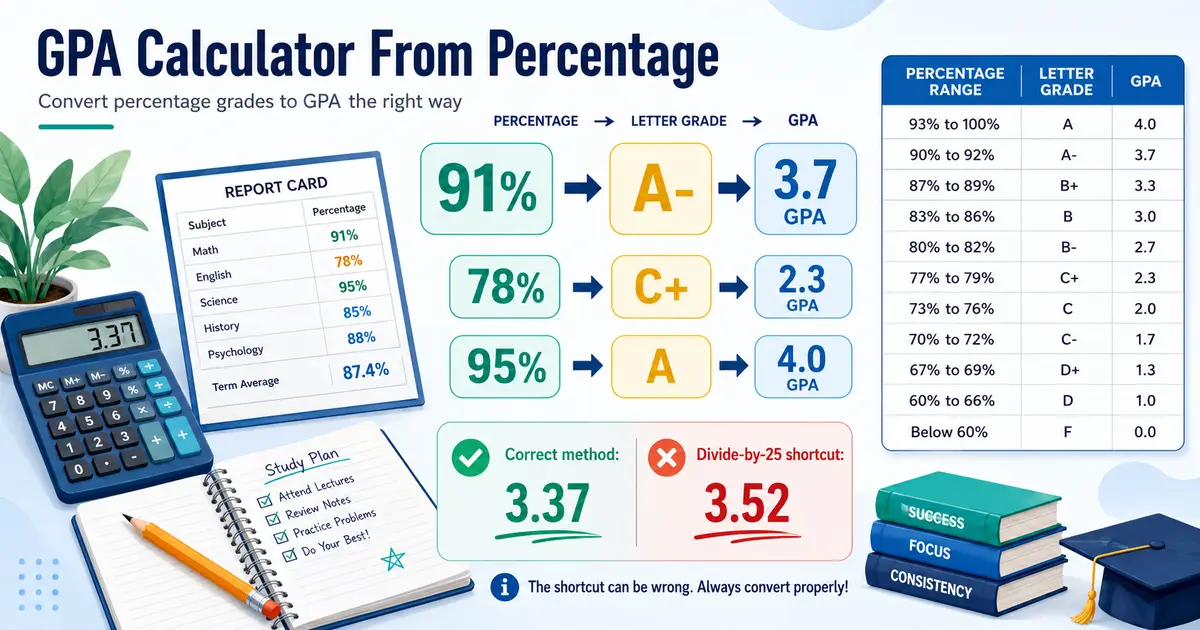
To convert a percentage grade to GPA, convert the percentage to a letter grade first using your school’s grading bands, then use the letter grade’s fixed GPA value, not a straight percentage-to-GPA formula. Most percentage-to-GPA calculators skip that first step and just divide your percentage by 25, which can quietly hand you the wrong number. Once you have each course converted to a letter grade and GPA value, run it through the GPA calculator to get your full credit-weighted result.
Why Percentage Grades Need Converting At All
A lot of US schools, and most schools outside the US, report grades as percentages rather than letters. But GPA, as used by US colleges, scholarship committees, and transcripts, runs on the 4.0 letter-grade scale. If your report card shows 91% instead of A-, that percentage has to be translated before it can be combined with other courses into a GPA. Getting a GPA from percentage grades this way, letter grade first, then grade point, is the part that trips people up, and it’s the difference this guide focuses on.
The Percentage-to-Letter-Grade Table
This is the standard scale, the same one used on our GPA calculator:
| Percentage | Letter Grade | Grade Points |
|---|---|---|
| 93% to 100% | A | 4.0 |
| 90% to 92% | A- | 3.7 |
| 87% to 89% | B+ | 3.3 |
| 83% to 86% | B | 3.0 |
| 80% to 82% | B- | 2.7 |
| 77% to 79% | C+ | 2.3 |
| 73% to 76% | C | 2.0 |
| 70% to 72% | C- | 1.7 |
| 67% to 69% | D+ | 1.3 |
| 60% to 66% | D | 1.0 |
| Below 60% | F | 0.0 |
Find your percentage in the left column, and the letter and grade point are right next to it. Once every course has a grade point, our percentage to GPA calculator turns those into a full GPA for you, credit-weighted and everything, without any manual math.
Why Not Just Divide by 25?
You’ll find plenty of tools online that convert percentage to GPA with a single formula: Percentage ÷ 25, or equivalently Percentage ÷ 100 × 4. It’s a clean piece of math, and for a rough, generic estimate it isn’t unreasonable. But it isn’t how US schools actually assign GPA, and it can produce a meaningfully different number than the letter-band method above.
Here’s why the two methods diverge: the divide-by-25 formula assumes GPA scales perfectly and continuously with percentage, so that every single percentage point matters equally. Real grading scales don’t work that way. They’re banded, an 86% and an 83% both land on a B and both convert to exactly 3.0, while an 87% jumps to a B+ and 3.3, even though it’s only one point higher than 86%. The bands aren’t evenly spaced either, some are 3 points wide, some are 6 or 7. A formula that treats percentage as continuously proportional to GPA will smooth right over that unevenness, and the result can end up noticeably higher or lower than what a school would actually report.
A Fully Worked Example: Three Courses
| Course | Percentage | Letter Grade | Grade Points | Credits | Quality Points |
|---|---|---|---|---|---|
| Biology | 91% | A- | 3.7 | 4 | 14.8 |
| English | 78% | C+ | 2.3 | 3 | 6.9 |
| Algebra II | 95% | A | 4.0 | 3 | 12.0 |
Add the quality points: 14.8 + 6.9 + 12.0 = 33.7 total quality points.
Add the credits: 4 + 3 + 3 = 10 total credits.
GPA = 33.7 ÷ 10 = 3.37.
Compare that to the divide-by-25 shortcut applied to the same three grades. Average the percentages first (91 + 78 + 95) ÷ 3 = 88%, then divide by 25: 88 ÷ 25 = 3.52. That’s 0.15 points higher than the correct, credit-weighted, letter-band result, and it comes from two compounding errors: the shortcut ignores credit-weighting entirely, and it treats percentage as linearly proportional to GPA when real grading scales are banded. For a student close to a scholarship or admissions cutoff, a gap that size is exactly the kind of thing worth getting right.
Common School Scale Variations
The table above is the most common version of the scale, but it isn’t universal, and confirming your own school’s exact bands matters more here than almost anywhere else in GPA math:
- Simplified whole-letter scales. Some schools skip plus/minus grades entirely and use flat bands instead: A = 90-100%, B = 80-89%, C = 70-79%, D = 60-69%, F = below 60%. Under this version, an 87% is simply a B (3.0), not a B+ (3.3), a meaningfully different result from the table above.
- Different percentage cutoffs. A handful of schools shift the exact boundary between grades by a point or two in either direction. A school where a B+ starts at 88% instead of 87% will convert an 87.5% differently than the standard table does.
- An A+ tier. Some schools add an A+ grade, worth either 4.0 (same as A) or slightly above at 4.3, typically for percentages in the high-90s or a perfect 100.
If your school’s scale doesn’t match the standard table, use its published version instead, the conversion method (letter band first, then grade point) stays the same either way.
Converting GPA Back to Percentage
Sometimes the conversion needs to run the other direction, for instance if a form asks for a percentage and your transcript only shows GPA. Since the letter-band method isn’t a single continuous formula, going from GPA back to an exact percentage isn’t as clean as the forward direction, a GPA of 3.0 could represent anywhere from 83% to 86%, since the whole B band collapses to the same grade point. What you can do is reverse the table: a GPA value points you to its corresponding letter grade and percentage range, just not a single exact percentage. If you need your precise original percentage back, your transcript or gradebook is the only fully accurate source, the grade point value alone can’t reconstruct it.
If You’re Converting From an International or 10-Point Scale
Not every percentage-to-GPA question is about the standard US 4.0 scale. Several countries, India in particular, report academic performance as a CGPA on a 10-point scale rather than a percentage or a 4.0 GPA, and the conversion formulas involved are genuinely different from what this guide covers. A common approach for that scale divides the percentage by 9.5 rather than converting through US-style letter-grade bands, since the underlying grading systems aren’t built the same way. If you’re converting a percentage or 10-point CGPA specifically for a US college application, check with that school’s admissions office on which conversion they expect, some recalculate incoming grades using their own formula rather than accepting a student’s self-converted number. This guide focuses specifically on the standard US letter-grade-band method described above, since that’s what StudentCalcTools’ own GPA calculator is built around.
Frequently Asked Questions
How do I convert percentage to GPA?
Convert your percentage to a letter grade first using your school’s grading bands, then use that letter grade’s fixed GPA value on the 4.0 scale. Avoid dividing percentage by 25 directly, since that skips the letter-grade step US schools actually use.
What if my school’s scale is different?
Use your school’s own published percentage bands instead of the standard table. The method is the same either way: find your letter grade first, then convert that letter to its GPA value.
Is 90% always an A-?
Not always. On the most common US scale, yes, 90% to 92% is A- (3.7). But some schools use different cutoffs or a simplified scale without plus/minus grades, where 90% might fall into a flat A band instead. Always check your own school’s scale before treating a conversion as official.
Is the divide-by-25 shortcut ever accurate?
It can land close to the correct answer for grades right in the middle of a band, but it consistently diverges near band edges and whenever credit hours differ between courses, since it doesn’t account for credit-weighting at all. For an exact result, convert through letter grades first.
Do I need to convert every course separately?
Yes. Convert each course’s percentage to a letter grade and grade point individually, then combine them using the credit-weighted GPA formula covered in how to calculate your GPA, rather than averaging the raw percentages first.
Can I convert my GPA back to an exact percentage?
Not precisely. Since the letter-band method groups a range of percentages into one grade point, a GPA of 3.0 could represent anywhere from 83% to 86%. Your original transcript or gradebook is the only fully accurate source for the exact percentage.
What if my percentage is from a 10-point or international scale?
Systems like India’s 10-point CGPA scale use different conversion formulas entirely, not the US letter-grade-band method this guide covers. If you’re converting for a US college application, check with that school’s admissions office, since many recalculate incoming grades using their own formula.
Can I skip the table and just use a calculator?
Yes, once you understand which method is accurate. StudentCalcTools’s GPA calculator applies the letter-band method automatically, so you can enter percentages directly without doing the lookup by hand.