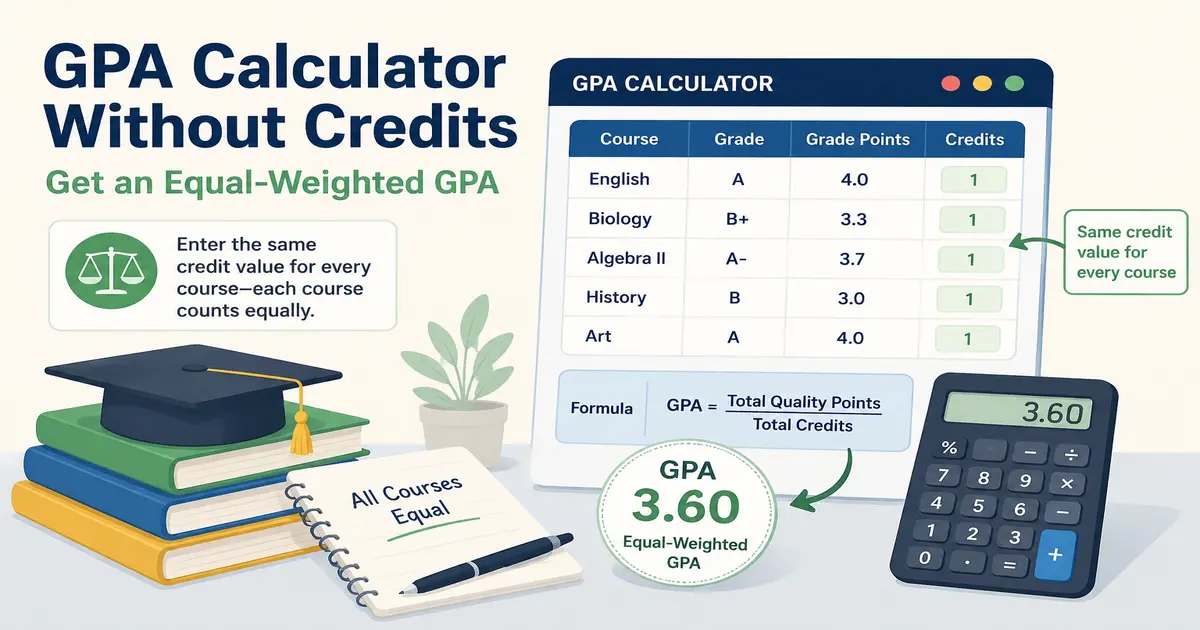
To calculate GPA without credit hours, enter the same credit value, such as 1, for every course in the GPA calculator. This produces a simple, equally-weighted average automatically, using the exact same formula the calculator already runs, just with every course carrying identical weight. You don’t need a separate GPA calculator no credits tool or a different method, only a different input.
When Schools Don’t Use Credit Hours
Not every school reports credit hours per course. This is especially common in middle school and junior high, where subjects like math, English, science, and electives are usually treated as equal parts of a report card, with no separate credit-hour value attached to any of them. Some high school programs work the same way, particularly standard, non-honors tracks where every course counts the same regardless of subject.
If that’s your situation, and your report card or gradebook simply doesn’t list credit hours anywhere, you’re not missing information, your school likely never assigned any. Every course counting equally isn’t a workaround, it’s an unweighted course average by design, the actual grading structure at schools like this. This same approach is also useful for a quick estimate before official grades post, if you know your likely letter grades but the credit-hour data hasn’t been entered into the system yet, an equal-weighted calculation gives you a reasonable placeholder number.
A related but separate case is zero-credit courses, things like labs, seminars, or orientation periods that appear on a transcript with a letter grade but are assigned 0 credit hours. In the standard credit-weighted formula, a 0-credit course contributes nothing at all, since any grade multiplied by zero credits equals zero, so these courses are effectively excluded from a credit-weighted GPA even though they show a grade. That’s different from a course genuinely being untracked for credit, and it’s worth knowing which situation you’re actually in before assuming a zero-credit class should be included in an equal-weighted calculation.
“Without Credits” Is Not the Same as “Unweighted”
These two terms get mixed up often enough that it’s worth separating them clearly. “Without credits” means every course counts as one equal unit, regardless of subject or workload. “Unweighted” means no extra points are added for course difficulty, an AP or IB class earns the same 4.0 for an A as a standard class does, with no bonus applied. A calculation can be both at once, treating every course equally and using the standard scale with no honors bonus, but they’re answering two different questions: one is about credit hours, the other is about course rigor. If your goal is specifically to remove AP or IB bonus points rather than to work around missing credit-hour data, that’s a separate calculation from what this guide covers.
Why Equal Weighting Still Uses the Same Formula
The standard GPA formula is credit-weighted: GPA = Total Quality Points ÷ Total Credits, where quality points come from multiplying each course’s grade points by its credit hours. It might seem like a school with no credit hours needs an entirely different calculation. It doesn’t, it needs the same formula with one simplification.
Here’s why: if every course is assigned the same credit value, call it k, then the formula becomes (Grade Point₁ × k + Grade Point₂ × k + … ) ÷ (k + k + …). Since k is multiplied into every term on both the top and bottom of that fraction, it cancels out completely, no matter what value k happens to be. What’s left is just the sum of the grade points divided by the number of courses, a plain average.
This means entering 1 credit for every course, entering 3 credits for every course, or entering any other constant number all produce the identical result, since the specific value of k never actually matters once every course shares it. That’s the entire logic behind the “enter the same credit value” instruction: it isn’t a simplified alternative formula, it’s the standard formula, correctly applied to a case where every course happens to carry equal weight.
Step-by-Step With the Calculator
- Open the GPA calculator and add one row per course.
- Select each course’s letter grade as usual.
- Enter the same credit value for every course. The specific number doesn’t matter, 1 is simplest, since it cancels out of the calculation either way.
- Calculate. The result is your equally-weighted GPA, mathematically identical to a plain average of your grade points.
A Fully Worked Example: Five Courses, No Credits Given
| Course | Grade | Grade Points |
|---|---|---|
| English | A | 4.0 |
| Biology | B+ | 3.3 |
| Algebra II | A- | 3.7 |
| World History | B | 3.0 |
| Spanish II | C+ | 2.3 |
Add the grade points: 4.0 + 3.3 + 3.7 + 3.0 + 2.3 = 16.3.
Divide by the number of courses: 16.3 ÷ 5 = 3.26.
If you ran this same set of grades through the GPA calculator with every course set to 1 credit, you’d get the same total quality points (16.3, since each grade point is multiplied by 1) divided by the same total credits (5, one per course), landing on the identical 3.26. The math doesn’t change, only how you’re entering it.
What Counts as a “Course” When There Are No Credits
Include every graded course unless your school’s transcript explicitly excludes it. Physical education, electives, and arts courses with a letter grade generally count in a no-credit average the same as core academic subjects, unless your school’s own policy says otherwise. If you’re not sure whether a specific course should be included, check your transcript’s own structure, if it’s listed alongside your other graded courses, treat it the same way in your calculation.
Is This the Same as a Simple Average?
Yes. A GPA calculated with every course carrying equal credit is mathematically identical to a simple GPA average of your grade points, sum the grade points, divide by the number of courses. The credit-hour step in the standard formula is still technically happening, it’s just neutralized because every course shares the same value.
When This Might Not Match Your Official Transcript
An equal-weighted calculation will match your school’s official GPA when every one of your courses genuinely carries the same credit value in your school’s own records. It won’t match if your school actually does assign different credit hours per course, even if that isn’t obvious from your report card, or if your school excludes certain grades from GPA entirely, such as pass/fail, audit, or withdrawn courses, a detail covered in more depth in how to calculate your GPA. If your manual result doesn’t match your transcript, checking those two things first is the fastest way to find the difference.
If You Need This Across Multiple Semesters
Everything above covers one term or one group of courses. If you want to combine an equal-weighted GPA with results from other semesters into a single cumulative figure, the CGPA calculator handles that roll-up the same way, no credit hours required there either, using the same equal-value approach.
StudentCalcTools has a full set of free calculators beyond GPA, including class rank, grade, and attendance tools, if you want to check something else while you’re at it.
Frequently Asked Questions
Can I calculate GPA without credit hours?
Yes. Enter the same credit value, such as 1, for every course in a standard GPA calculator. This produces an equally-weighted average using the same underlying formula, without needing a separate tool.
What number do I enter if my school has no credits?
Any consistent number works, since it cancels out of the calculation, but 1 is the simplest choice and the one most calculators, including ours, recommend by default.
Is this the same as a simple average?
Yes. Assigning every course the same credit value and running it through the standard credit-weighted formula produces a result that’s mathematically identical to a plain average of your grade points.
Will my no-credits GPA match my official transcript GPA?
Only if your school genuinely assigns equal credit to every course. If your school’s actual records use different credit values per course, or exclude certain grades from GPA entirely, your calculated number may not match exactly.
Do electives and PE count in a no-credits GPA?
Generally yes, if they appear as graded courses on your transcript alongside your other classes, unless your school’s specific policy excludes them.
Do zero-credit courses count toward my GPA?
No, not in a standard credit-weighted calculation. A course assigned 0 credit hours contributes nothing to the formula, since any grade multiplied by zero equals zero, even though the course still shows a letter grade on the transcript.
Is “without credits” the same as “unweighted”?
No, they answer different questions. Without credits means every course counts as one equal unit regardless of workload. Unweighted means no bonus points are added for AP or IB course difficulty. A calculation can be both at once, but they aren’t interchangeable terms.
Why not just use a dedicated “simple average” GPA calculator instead?
You can, and the result will be the same, but you don’t need a separate tool. The standard credit-weighted formula already produces an equal-weighted average once every course shares the same credit value, so one calculator handles both cases.