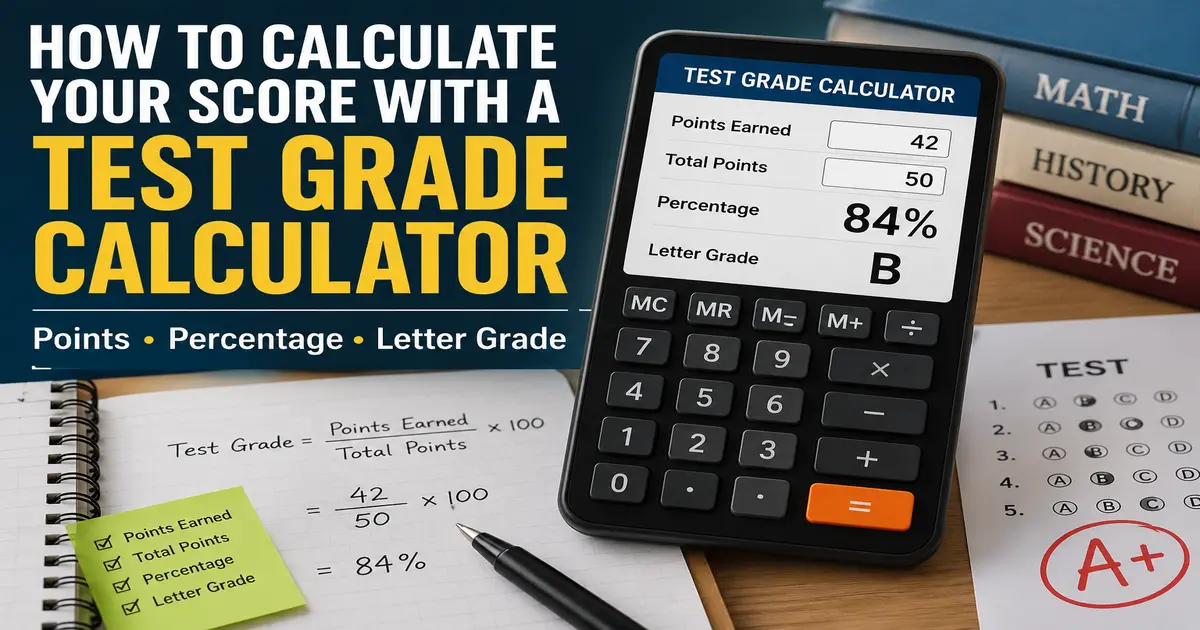
Use our test grade calculator to convert the points you earned into a percentage, estimate your letter grade, and see how the test may affect your overall course grade.
At StudentCalcTools, you can calculate the result without guessing or manually working through every step. You only need your points earned, total possible points, and the grading scale used by your teacher.
The basic calculation is simple:
Test percentage = Points earned ÷ Total points × 100
For example, earning 42 points on a 50-point test gives you:
42 ÷ 50 × 100 = 84%
On a common grading scale, 84% would be a B. However, your teacher or school may use different letter-grade cutoffs, rounding rules, curves, or plus and minus grades. Always compare the result with your syllabus or official gradebook.
Key Takeaways
- Divide points earned by total possible points and multiply by 100.
- A score of 42 out of 50 equals 84%.
- Convert the percentage into a letter grade using your teacher’s grading scale.
- Tests with different point totals should be combined using total earned and total possible points.
- Weighted tests must be calculated according to how much each test counts.
- Extra credit, dropped questions, curves, and rounding can change the final result.
- A classroom test percentage is not the same as an official AP Exam score from 1 to 5.
What Does a Test Grade Calculator Calculate?
A test grade calculator usually answers four related questions:
- How many points did you earn?
- What percentage of the test did you complete correctly?
- What letter grade does that percentage represent?
- How much does the test contribute to your course grade?
These calculations are related, but they are not identical.
For example, 42 out of 50 is your points score. Converting it to 84% gives you your test percentage. Your teacher may then classify 84% as a B, B minus, or another letter grade according to the course grading scale.
If the test counts for 20% of your course, the 84% score contributes 16.8 percentage points toward the final course grade:
84 × 0.20 = 16.8
That weighted contribution is different from the 84% test result itself.
Test Grade Calculator Formula
Use the following formula when your test is graded with points:
Test grade percentage = Points earned ÷ Total points possible × 100
The calculation has three steps:
- Divide your earned points by the maximum available points.
- Multiply the result by 100.
- Compare the percentage with the correct letter-grade scale.
Example
Suppose you earned 37 points on a test worth 45 points.
37 ÷ 45 = 0.8222
Multiply by 100:
0.8222 × 100 = 82.22%
Your test grade is approximately 82.22%.
Using a basic A, B, C, D, and F scale, that would normally fall within the B range. Your official result may differ if your class uses plus and minus grades or another grading system.
Points-to-Percentage Test Grade Examples
The same formula works for tests, quizzes, exams, worksheets, projects, and other point-based assessments.
| Points Earned | Total Points | Percentage |
|---|---|---|
| 18 | 20 | 90% |
| 42 | 50 | 84% |
| 73 | 80 | 91.25% |
| 86 | 100 | 86% |
| 132 | 150 | 88% |
| 178 | 200 | 89% |
Never treat the number of earned points as the percentage unless the assessment is worth exactly 100 points.
For example, 42 points does not automatically mean 42%. On a 50-point test, 42 points equals 84%.
How to Convert a Test Percentage Into a Letter Grade
The table below shows a common grading scale used for simple estimates.
| Percentage | Estimated Letter Grade |
|---|---|
| 90% to 100% | A |
| 80% to 89.99% | B |
| 70% to 79.99% | C |
| 60% to 69.99% | D |
| Below 60% | F |
This table is only a general reference. Schools and teachers may use:
- Plus and minus grades
- Different percentage boundaries
- Standards-based grading
- Pass or fail grading
- Curved grading
- Rubric-based grading
- Minimum competency requirements
The University of Arizona’s syllabus policy, for example, requires course syllabi to explain the grading scale, evaluation methods, and how assessments contribute to the final grade. That is why your official course syllabus should take priority over a general conversion table.
How to Calculate a Test Grade From Correct Answers
Some tests show the number of correct and incorrect answers rather than points.
When every question has the same value, use:
Test percentage = Correct answers ÷ Total questions × 100
Suppose a test contains 50 equally weighted questions and you answer 43 correctly.
43 ÷ 50 × 100 = 86%
Your test grade is 86%.
You can also start with the number of incorrect answers:
Correct answers = Total questions − Incorrect answers
If you missed 7 questions out of 50:
50 − 7 = 43 correct answers
Then:
43 ÷ 50 × 100 = 86%
This method only works when every question is worth the same number of points. If essay questions, multiple-choice questions, or short responses have different values, calculate the grade using points earned instead.
How to Calculate the Average of Multiple Test Grades
An average test grade calculator can use two different methods. The correct method depends on whether all tests have equal value.
Method 1: Simple Average
Use a simple average when every test counts equally.
Average test grade = Sum of test percentages ÷ Number of tests
Suppose your test scores are:
- Test 1: 90%
- Test 2: 72%
- Test 3: 76%
Add the percentages:
90 + 72 + 76 = 238
Divide by three:
238 ÷ 3 = 79.33%
Your simple test average is 79.33%.
Method 2: Combined Points Average
Use combined points when tests have different maximum scores and every point has equal value.
Suppose your results are:
| Test | Points Earned | Points Possible | Test Percentage |
|---|---|---|---|
| Test 1 | 18 | 20 | 90% |
| Test 2 | 36 | 50 | 72% |
| Test 3 | 76 | 100 | 76% |
Add all earned points:
18 + 36 + 76 = 130
Add all possible points:
20 + 50 + 100 = 170
Calculate the combined grade:
130 ÷ 170 × 100 = 76.47%
The combined points grade is 76.47%, not 79.33%.
The results differ because the 100-point test has more influence than the 20-point test. Before averaging scores, check whether your teacher treats each test equally or combines all test points.
How a Weighted Test Grade Calculator Works
A weighted test grade calculator is needed when some tests count more than others.
Use this formula:
Weighted test average = Sum of each test score × its weight
Suppose you have three test grades:
| Test | Score | Weight | Weighted Contribution |
|---|---|---|---|
| Test 1 | 90% | 20% | 18 |
| Test 2 | 80% | 30% | 24 |
| Test 3 | 70% | 50% | 35 |
Add the weighted contributions:
18 + 24 + 35 = 77
Your weighted test average is 77%.
The simple average would have been 80%, but that would be misleading because the lowest test had the greatest weight.
For a deeper explanation of category and assignment weighting, read our weighted grade calculator guide.
How to Calculate a Semester Grade With Test Scores
A semester test grade calculator must include more than test scores when homework, quizzes, participation, projects, or final exams also count toward the course.
Suppose your semester is divided into these categories:
| Category | Grade | Course Weight | Contribution |
|---|---|---|---|
| Homework | 92% | 25% | 23.00 |
| Quizzes | 86% | 20% | 17.20 |
| Tests | 81% | 35% | 28.35 |
| Final exam | 88% | 20% | 17.60 |
Add the contributions:
23 + 17.2 + 28.35 + 17.6 = 86.15
Your estimated semester grade is 86.15%.
Do not average 92%, 86%, 81%, and 88% directly. The categories do not have equal weights.
If you are trying to determine what score you need on an upcoming exam rather than calculate a completed test, use the final grade calculator. It works backward from your current grade, target grade, and exam weight.
Test Grade Calculator for Teachers
A test grade calculator for teachers can reduce repetitive calculations when grading an entire class.
For each student:
- Enter the points earned.
- Divide by the total available points.
- Multiply by 100.
- Apply the course grading scale.
- Record the result using the required rounding rule.
A teacher test grade calculator can also help calculate the class average.
Use:
Class average = Sum of student percentages ÷ Number of students
Suppose five students earn:
- 78%
- 84%
- 91%
- 87%
- 80%
Add the scores:
78 + 84 + 91 + 87 + 80 = 420
Divide by five:
420 ÷ 5 = 84%
The class average is 84%.
However, the average alone does not explain the complete score distribution. Two classes can have the same average but very different numbers of high and low scores. Teachers may also review the median, highest score, lowest score, question difficulty, and common errors before interpreting class performance.
Can You Use It as an AP World History Test Grade Calculator?
You can use the points formula for an AP World History classroom test when your teacher provides points earned and total points.
For example:
44 points earned ÷ 55 points possible × 100 = 80%
That calculation gives you the classroom test percentage.
It does not automatically predict your official AP World History Exam score.
According to the College Board’s official AP score guidance, AP Exams are reported on a scale from 1 to 5. For most AP Exams, the final score is based on a weighted combination of multiple-choice and free-response sections.
The cut points used to convert a composite score into an AP score are not the same as a standard classroom A-to-F grading scale. Therefore, an AP World History test grade calculator can calculate your raw classroom percentage, but it should not claim that a particular percentage guarantees an official AP score.
Important Edge Cases
The Test Has Different Point Values
Do not count correct questions when questions carry different values.
A five-point essay should affect the grade more than a one-point multiple-choice question. Add the points actually earned and divide by the total available points.
A Question Was Dropped
Remove the dropped question’s value from the total possible points.
If a test was originally worth 50 points but a two-point question was removed, calculate the grade out of 48 points.
For example:
42 ÷ 48 × 100 = 87.5%
Do not continue dividing by 50 unless the teacher says the removed question will be treated differently.
Extra Credit Raises the Score Above 100%
Extra credit may produce a result greater than 100%.
For example:
53 ÷ 50 × 100 = 106%
Whether the full 106% is recorded depends on the teacher’s policy. Some courses cap individual test grades at 100%, while others allow the extra points to increase the course average.
The Teacher Applies a Curve
Calculate the raw score first. Apply the curve only after you know the teacher’s exact method.
A curve might:
- Add a fixed number of points
- Add a percentage
- raise the highest score to 100%
- Adjust letter-grade boundaries
- Remove a difficult question
- Use a statistical distribution
Do not assume that every curve adds the same number of points to every student.
Partial Credit Creates Decimal Scores
The formula works with decimals.
If you earn 36.5 points out of 45:
36.5 ÷ 45 × 100 = 81.11%
Keep several decimal places during the calculation and round only at the end.
The Total Points Are Zero
A test grade cannot be calculated when the total possible points equal zero. Division by zero is undefined.
Check whether the test has been entered correctly or whether the assignment has not yet been graded.
The Gradebook Shows Missing Work
Some gradebooks treat missing work as zero, while others temporarily exclude it from the average.
Confirm whether blank assignments are:
- Ungraded
- Excused
- Missing
- Late
- Recorded as zero
This distinction can significantly change your course average.
Your Result Is Near a Letter-Grade Boundary
A score of 89.5% does not automatically become an A.
One teacher may round 89.5% to 90%. Another may retain the exact value. A third may use 89.5% as the official A cutoff.
Use the rounding policy written in the syllabus rather than assuming the result will be rounded in your favor.
Common Test Grade Calculation Mistakes
| Mistake | Why It Produces the Wrong Result |
|---|---|
| Dividing total points by earned points | The correct order is earned points divided by total points |
| Forgetting to multiply by 100 | The decimal must be converted into a percentage |
| Treating points as percentages | 42 out of 50 is 84%, not 42% |
| Averaging unequal tests equally | Larger tests may need more influence |
| Ignoring category weights | Tests may count differently from homework or quizzes |
| Counting questions instead of points | Questions may have different point values |
| Using a generic letter scale | Your teacher may use different cutoffs |
| Rounding too early | Early rounding can slightly change the result |
| Applying an unknown curve | Curves must follow the teacher’s stated method |
| Predicting an AP score from a classroom percentage | Official AP scores use a separate 1-to-5 process |
How to Use Your Test Grade Result
Once you calculate your test score, decide what the number means for the course.
Ask:
- Is the score above the passing requirement?
- Does it improve or lower my test average?
- How heavily is the test weighted?
- Am I close to a different letter grade?
- Do I have remaining tests or assignments?
- Does the course grade affect my GPA?
- Is the gradebook using the same scale as my syllabus?
When the estimated course grade is available, use a GPA calculator to see how the final letter grade may affect your academic average.
Final Thoughts
Calculating a test grade begins with two numbers: points earned and total possible points.
Use:
Test percentage = Points earned ÷ Total points × 100
A score of 42 out of 50 equals 84%. From there, compare the percentage with your teacher’s grading scale and check whether the test has a particular weight in your course.
The arithmetic is straightforward, but the grading policy still matters. Curves, extra credit, dropped questions, category weights, and rounding rules can all change the official result.
Enter your score and test weight into the calculator linked at the beginning of this guide to calculate your result quickly and see how it contributes to your overall class grade.
Frequently Asked Questions
How do I calculate my test grade from points?
Divide the points you earned by the total possible points and multiply by 100. For example, 42 out of 50 equals 42 ÷ 50 × 100, or 84%.
What grade is 18 out of 20?
Eighteen divided by 20 equals 0.90. Multiply by 100 to get 90%.
How do I calculate a test grade from wrong answers?
Subtract the number of incorrect answers from the total number of questions. Divide the correct answers by total questions and multiply by 100. This only works when all questions have equal value.
How do I calculate the average of several tests?
Add the percentages and divide by the number of tests when all tests count equally. When tests have different point totals, add all earned points and divide by all possible points.
Can teachers use the calculator?
Yes. Teachers can calculate individual percentages from points, convert percentages into letter grades, and calculate class averages. Official grading policies and rounding rules should still be applied separately.
What is the difference between a test grade and a semester grade?
A test grade measures performance on one assessment. A semester grade combines tests with other coursework, such as quizzes, homework, projects, participation, and final exams.
Can a test grade be higher than 100%?
Yes, extra credit can produce a result higher than 100%. Whether the additional percentage counts toward the course grade depends on the teacher’s policy.
Can this predict my AP World History Exam score?
No. It can calculate a classroom percentage from points, but official AP Exams use weighted section scores and report results on a 1-to-5 scale.