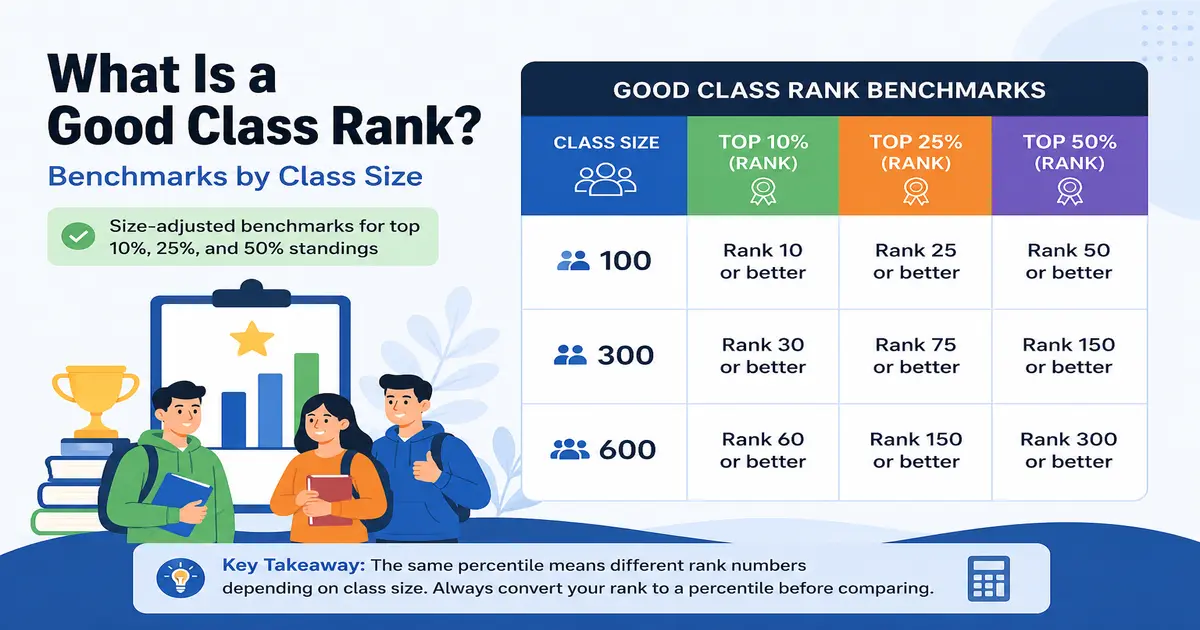
A good class rank depends on your goal and your class size, but as a general shorthand, top 10 percent is considered strong for most selective colleges and scholarships, top 25 percent is solidly competitive, and top 50 percent is average or above. What those numbers mean in raw terms changes a lot depending on how big your graduating class is. Ranked 25th sounds identical whether your class has 100 students or 600, but one is the very top of the class and the other is closer to the middle, which is why a size-adjusted answer matters more than a flat rule.
If you already know your rank and class size, the class rank calculator converts it into a percentile instantly so you can compare it against the benchmarks below.
Why “Good” Depends on Your Goal First
Before looking at any table, it helps to know what you’re actually measuring your rank against, because the bar moves depending on the goal:
- Any four-year college: most schools don’t require a specific rank at all, and a large share no longer report it as an admissions factor.
- Selective or Ivy-tier colleges: rank becomes one data point among many, and top 5 to 10 percent is typically viewed as strong, though it’s far from the only thing that matters.
- State auto-admission programs: some states guarantee admission to in-state public universities at a specific rank cutoff, most commonly somewhere in the top 6 to 10 percent, depending on the state and the specific university.
- Merit scholarships: many scholarship programs use rank as a screening criterion, and thresholds here vary widely, from top 10 percent for the most competitive awards to top 25 or even top 50 percent for broader programs.
- Honor societies and honor programs: these often set their own rank cutoff, frequently somewhere in the top 10 to 20 percent range, separate from college admissions entirely.
The rest of this guide breaks each of these down with real numbers.
The General Benchmark Shorthand
| Standing | General Read |
|---|---|
| Top 10% | Strong for most selective colleges, honors programs, and many scholarships |
| Top 25% | Solidly competitive; a common cutoff for broader merit scholarships and some state programs |
| Top 50% | Average or above; rarely a differentiator on its own, but not a red flag either |
| Below 50% | Rank alone won’t carry the application; course rigor, GPA trend, and other factors matter more |
This shorthand is where almost every competing article stops. It’s a reasonable starting point for a good class rank percentile, but “top 10 percent” means a very different raw rank depending on class size, which is the part worth actually working through.
How Class Size Changes the Answer
This is the core problem with a flat “top 10 percent” rule: the same percentile ranking translates into wildly different raw numbers depending on how many students are in the graduating class.
| Class Size | Top 10% (Rank) | Top 25% (Rank) | Top 50% (Rank) |
|---|---|---|---|
| 100 | Rank 10 or better | Rank 25 or better | Rank 50 or better |
| 300 | Rank 30 or better | Rank 75 or better | Rank 150 or better |
| 600 | Rank 60 or better | Rank 150 or better | Rank 300 or better |
Notice what this means in practice: a rank of 30 is a top 10 percent standing in a class of 300, using the ((Total Students − Rank + 1) ÷ Total Students) × 100 formula that gives a 90.3rd percentile for that exact position. But that same rank 30 in a class of 100 wouldn’t even exist (there aren’t 30 students below it to speak of), and in a class of 600 it would be closer to top 5 percent, a noticeably stronger standing.
The practical takeaway: never compare a raw rank number across two different schools without converting both to a percentile first. For the full mechanics of how that conversion works, including where percentile and top percent aren’t always exact mirror images of each other, see percentile vs percentage vs top %.
Is My Rank Competitive For…
Selective or Ivy-Tier College Admissions
Top 5 to 10 percent is generally viewed as strong at highly selective colleges, though these schools use holistic review, meaning rank is one factor considered alongside course rigor, essays, test scores where required, and extracurriculars, not a standalone cutoff. Rank’s actual weight has also shrunk in recent years: in NACAC’s most recent survey of four-year colleges, only 5.5 percent rated high school class rank as carrying “considerable importance” in admission decisions, down from roughly 13 to 15 percent a decade earlier, while grades in college-prep courses and strength of curriculum remain rated considerably important by more than three-quarters of colleges (National Association for College Admission Counseling, Factors in the Admission Decision). If your school doesn’t rank, a strong GPA and rigorous course load carry the weight rank would have otherwise, and increasingly they carry more weight than rank does even at schools that still report it.
State Auto-Admission Programs
Several states guarantee admission to at least one in-state public university based on class rank, and the specific cutoff varies by state and by university. These programs are usually set somewhere in the top 6 to 10 percent range for the most selective flagship campuses, with broader eligibility at other in-state schools. Because these rules are state-specific and change over time, check your own state’s current policy and your target university’s exact cutoff rather than relying on a general number.
Merit Scholarships
Rank shows up frequently as a scholarship screening factor, and the bar depends heavily on how competitive the specific award is. The most competitive national scholarships often expect top 10 percent, while many broader institutional or local scholarships accept top 25 percent, and some set the bar as low as top 50 percent. If you’re weighing how your standing affects your aid prospects, the scholarship calculator can help you estimate what a given award or cost gap actually looks like once you factor in your numbers.
Honor Societies and Honor Programs
Honor societies typically set their own rank-based cutoffs, separate from college admissions requirements. The Cum Laude Society, one of the oldest academic honor societies for high schoolers, generally elects up to the top 20 percent of the senior class, with some chapters electing part of that group as early as the top 10 percent at the midpoint of junior year (Cum Laude Society, Membership Requirements). Other honor programs set their own thresholds, so check the specific society’s published policy rather than assuming a single standard applies everywhere.
When a Lower Rank Isn’t a Problem
A rank outside the top 25 or top 50 percent doesn’t automatically weaken an application the way it might seem to. Colleges that consider rank almost always look at it in context: how rigorous the available coursework was, whether the school is highly competitive overall, and how the GPA trend moved over time. This cuts both ways. A student in the middle of the pack at an extremely competitive school, where dozens of classmates cluster near a 4.0, is often viewed very differently than a student with the same numeric rank at a less competitive one, since the middle of a strong class can still represent excellent work. It’s part of why many highly competitive private schools have moved away from reporting exact rank at all: when too many students are bunched near the top of the GPA scale, a strict numeric cutoff can understate how strong a student genuinely is relative to a national applicant pool. Rank is contextual information, not a standalone judgment.
Quick Self-Check
To see where your own numbers actually land:
- Confirm your current cumulative GPA and your school’s total class size.
- Run both through the class rank calculator to get your percentile.
- Compare that percentile against the goal that matters most to you, selective admissions, an auto-admission cutoff, a specific scholarship, or an honor program, using the benchmarks above.
If you’re not sure how your rank was calculated in the first place, how class rank is calculated walks through the full method, including how tied GPAs are handled.
Frequently Asked Questions
What’s a good class rank for college?
Top 10 percent is generally considered strong for selective colleges, top 25 percent is solidly competitive, and top 50 percent is average or above. The exact bar depends on which colleges or programs you’re targeting.
Is top 10% a good class rank?
Yes. Top 10 percent is typically viewed as strong across selective college admissions, many merit scholarships, and most honor programs.
Does class size matter for what counts as a good rank?
Yes, significantly. The same percentile standing translates into very different raw rank numbers depending on class size, so always compare percentile rather than raw rank across schools.
Is top 25% competitive for scholarships?
Often, yes. Many merit scholarship programs set their cutoff around top 25 percent, though the most competitive national awards may expect top 10 percent, and some broader programs accept top 50 percent.
What if my class is very small, like 50 students?
In a small class, each rank position is worth a larger percentage swing (2 percentage points per rank in a class of 50), so a specific numeric rank moves the percentile faster than it would in a large class. Convert to percentile before comparing against a benchmark meant for a larger school.
Does a lower class rank hurt my chances at every college?
No. Many colleges no longer report or weigh exact class rank heavily, and use holistic review that considers course rigor, GPA trend, and other factors alongside or instead of rank. For the full picture of how much rank still matters today, StudentCalcTools covers this in more detail in a dedicated pillar guide on the topic.